Long Shot

By Ed Staskus

   When I pulled into the parking lot of the Back Wall Racquetball Club in Solon and got out of my car I saw I was parked next to the Roselawn Cemetery. I needed some fresh air after the long drive so I went for a walk there. It wasn’t a big graveyard. I circled it and then took a hard-packed path through the middle of it. I almost tripped on the exposed roots of a large pin oak tree. “Watch your step,” I reminded myself.

   All of the headstones looked old. Some were leaning and others were nearly turned over. Two of the headstones next to one another were Abram and Eliza Garfield’s plots. They had been the parents of President James Garfield. Abram died in 1833 when his son was a baby. James Garfield was assassinated in 1881. His mother died in 1888 and was buried beside Abram. James got a large tomb elsewhere.

   It was a sunny summer day in 1980, the kind of day that made you glad to be alive. I went into the Back Wall. It was brand new, ten racquetball courts, three of them with glass back walls, a Nautilus physical training room, and large locker rooms on the second floor. I was there to apply for the job of Club Pro and Activities Director.

   Marty, who was the manager I had talked to on the telephone, came out of his office behind the front desk. We shook hands and introduced ourselves. He was about my age, but dressed much better than me. He was on the small side, trim and fit. He seemed smug, although I didn’t want to jump to conclusions. I found out later he was both smug and overweening.

   I filled out an application. The facts I wrote down were true as far as they went, although the rest of it was more sketchy than not. I played racquetball well enough to play in the Open class, but that was about it. I had no experience to speak of working in a sports club. In any case, Marty only glanced at the application. He asked me if I had time to play a game. I was wearing sneakers, but didn’t have anything else with me. He outfitted me with a pair of shorts and a ratty t-shirt. He handed me a racquet that looked like it had been manufactured in the Middle Ages.

   “Let’s see what you’re made of,” he said.

   He was natty in his Nike sportswear. He scored the first eight points. Those were the last points he scored. I got cracking and won the game 21 – 8.

   “Let’s play another one,” he said. “I’m just getting warmed up.”

   I won the second game by the score of 21 – 1.

   “All right, you seem to play the game well enough,” he said, more grudging than not. He told me I could start on Monday. “Get some better clothes. Make sure you look the part.”

   I bought an Adidas warm-up suit on Saturday and showed up for work on Monday. The Back Wall supplied me with monogrammed polo shirts. I checked myself out in the full-length mirror in the men’s locker room. I looked like I had just stepped out of the fridge. I was in business.

   The business was easier than I thought it was going to be. I started at ten in the morning, gave lessons to housewives most mornings, had a late lunch, gave lessons to children and more housewives in the afternoon, and got in a practice session on my own before the after-work crowd showed up. I didn’t work evenings unless an event, like an in-house competition of some kind, was going on. We hosted Ohio Racquetball Association tournaments now and then. It meant working weekends, but it was more of a good time than work. I strung racquets on the side, half of the remittance going to me, the other half going to the club. I filled in at the front desk whenever the need arose.

   I made friends with one of the daytime front desk receptionists. Rose was in her 30s, tall and gangly. She didn’t have much of a chin, but was  lively with a ready smile. I also made friends with the cleaning lady. Her name was Zala. One day I asked her what the name meant.

   “It’s Slovenian,” she said. “It means small castle.”

   She was built like a small castle, short and squat. One reason the club stayed clean was that everybody feared the ogress she became whenever somebody made a mess and she had to clean it up. She sewed headbands for me made from club towels. She hemmed them so they stayed neat. I always had a half dozen of them in my gym bag. 

   I played some of the club’s members occasionally. One of them was Wayne Godzich, who was a detective with  the Solon Police Department. He had wide set eyes, thin lips, and a great head of hair for a man his age. He rarely talked shop, but one day, sitting around in the lobby after a game, I asked him how it was that he became a policeman.

   “I got out of the army in the mid-60s. tried this and that, and finally filled out an application here,” he said. “I passed the basic physical and psychological tests and, just like that, I was on the force. I went to the academy nights, but I basically learned on the job. My first day on the job, that was in 1968, I was escorted into the office of the lieutenant, who handed me a badge, a gun, a box of bullets, and then told a sergeant to “take him down to the dump on Crocker Road” to see if I could shoot. I was a motorcycle officer, a narcotics officer, and finally made it onto the detective bureau.”

   Another member I played occasionally was Bo Natale. His name was actually Beauregard, but he went by Bo. He came to the club every day in the afternoon since he worked nights. He played racquetball and worked out on the Nautilus machines. He showered and shaved afterwards. He was a harness racing driver. He was a catch driver, which meant he was a hired hand. He didn’t train and drive his own horses. He was hired by trainers and owners to drive their horses. He was driving at the Northfield Park track that summer. The half-mile track was about fifteen minutes south of Solon.

   There were a couple of hundred dates at Northfield Park that year. Bo didn’t drive every date since he was only there for the three summer months, although he drove every date he was there. He lived in his own trailer, which he hauled around the country with a brand new red and white Ford F-150. He was a catch driver who followed the circuits and the weather. He lived in Oklahoma when he wasn’t racing.

   “I don’t get home much,” he said. “The wife likes it that way. We get along better.”

   Bo wasn’t a skinny man, like thoroughbred jockeys. He was closer to two hundred pounds than one hundred pounds. He wasn’t especially tall, either. “You don’t want to be too tall in the racebike,” he said. That was what he called the sulky. Taller drivers sit higher in the sulky, raising the overall center of gravity, impacting stability, particularly when rounding turns.

   He wasn’t a very good racquetball player, but he was strong and tireless. I usually hit passing shots, rather than kill shots, when playing him, or I kept him in the back corners with ceiling shots. He was affable enough. I started offering him advice. He didn’t mind it. He was a quick study and got better over the course of the summer.

    It was early September when he told me he was going to be moving on at the end of the week.

   “I’ve got something for you, in return for your pointers, if you’re interested,” he said.

   “What’s that?” I asked. 

   “A tip,” he said.

   “A tip on what?”

   “A race.”

   “A tip about who’s going to win?” 

   “That’s right.”

   “I don’t know,” I said. “I’m not big on gambling.”

   I never gambled on anything. I didn’t even play the new Ohio Lottery.  I didn’t have money I could afford to lose. I knew full almost everybody lost when betting on the horses. On top of that, tracks skimmed a takeout which made the odds even longer. Gambling businesses prey on psychological weaknesses and the excitement of winning and losing. I had been raised a Catholic and still believed gambling encouraged greed and vice.

   “Take it for what it’s worth,” Bo said. “The horse is Adios Harry in the seventh. Bet him to win.”

   In the event, I went to Northfield Park after work on Friday. I had never been there before. It went back to 1935 when it was built by Al Capone as a dog race track. When dog racing didn’t work out it was converted into a stock car racing track. Twenty years later the last car race was run and in 1957 it became Northfield Park.

   I got there after the first race. I had to hike from the far end of the parking lot to the grandstand. It was “Date Night” at the track. The place was overflowing with guys and gals. I found a seat and looked down at the oval dirt track. It was called “The Home of the Flying Turns.” I watched a couple of races.

   Horse racing is an ancient sport. It goes back to the chariot races of Greece and Rome. In the Middle Ages knights raced horses as part of their military training. In the 17th century racing horses became a formalized sport in England. It spread worldwide from there. The races I watched at Northfield Park were full of life. One of them was a down to the wire crapshoot. Before the seventh race came up I went to place my bet.

   The mutuel windows were in a dedicated betting hall. The windows were small, their openings recessed. A glass barrier separated the bettors from the clerks. When my turn in line came up I pushed $50.00 towards the clerk. It was more money than I earned in a day. He had a cash register kind of machine in front of him. There was a keypad. He punched in my $50.00 to win on Adios Harry. He handed me a printed ticket. I went back to my seat. Adios Harrry was going at ten to one at post time. He seemed like an unlikely contender.

   There were eight horses lined up at the starting gate. Bo wasn’t driving any of the sulkies. Adios Harry, despite the odds, was a fine looking horse. He was black with muscular hindquarters and large nostrils. He didn’t look like he was going to be lacking for air. The race began when a Cadillac Fleetwood, equipped with a pair of retractable wings that served as gates, pulled away from the horses at the starting line. 

   It was a one mile race. At the start Adios Harry slipped back into last place. It didn’t look good for my $50.00. At a quarter mile he was in fourth place. At the half mile mark he moved up to third place. When the sulkies hit  the stretch he was in first place. As the pack came around to the front of the grandstand their hooves were pounding. I found myself on my feet, encouraging my horse until I was out of breath. Adios Harry won going away. I whooped and started clapping. I rushed to the betting hall.

   At the mutuel window the clerk gave me $550.00 in cash.

   “I thought I won $500.00,” I said. 

   “You did,” the clerk said. “You also get your $50.00 bet back.”

   “Thanks, that’s white of you.” When he gave me a funny look I realized he was African American.

   The next Friday, my winnings from the week before tucked away, I was leaving work, walking to my car, when Wayne Godzich drove up. He had his gym bag with him. He gave me a wave.

   “I heard you went to the track,” he said.

   “I thought I would check it out.” I didn’t ask him how he knew. He was a detective, after all.

   “Did you have a good time?”

   “It was an experience.”

   “Win any money?”

   “You know, you win some, you lose some.”

   “You’re not going to make it a habit, are you?”

   “No, I don’t think so. It was more of a one-off than anything else.”

   “That’s good,” he said. “It’s the house that always wins. Gambling is a sure way of getting nothing for something.” He clapped me on the back and went inside the club.

   I never went back to Northfield Park and never saw Bo again. Without his insight marching up to the mutuel windows would have just been taking a chance. Losing at race tracks happens when you don’t know what you’re doing. I didn’t know what I was doing so I didn’t take a chance.

Ed Staskus posts monthly on 147 Stanley Street  http://www.147stanleystreet.com, Made in Cleveland http://www.clevelandohiodaybook.com, Down East http://www.redroadpei.com, and Lithuanian Journal http://www.lithuanianjournal.com. To get the site’s monthly feature in your in-box click on “Follow.”

“Bomb City” by Ed Staskus

“A police procedural when the Rust Belt was a mean street.” Sam Winchell, Beyond Books

Available on Amazon: https://www.amazon.com/dp/B0F1LM1WF9/ref=sr_1_1?crid=2MYAQAOZIC2U9&dib=eyJ2IjoiMSJ9.hTm7BGbiQbSe5ZapFwYPPfcwOpTe-Vdg6VLE4aGyTyk.Z0R-VNBWWEcvKcNaO9LdCOUnNIOOXgvYkRS_FXiXuHk&dib_tag=se&keywords=bomb+city+ed+status&qid=1742136726&sprefix=bomb+city+ed+staskus%2Caps%2C84&sr=8-1

Cleveland, Ohio 1975. The John Scalish Crime Family and Danny Greene’s Irish Mob are at war. Car bombs are the weapon of choice. Two police detectives are assigned to find the bomb makers. Revenge is always personal. It gets personal.

A Crying of Lot 49 Publication

Breaking and Entering

By Ed Staskus

   The first thing Oliver and Emma’s father did when he pulled into the St. Ignatius High School parking lot on the near west side of Cleveland was park the car, get out, and take his children on a tour of the campus.

   “It’s a lot different than when I was here,” he told them.

   “When was that, dad?”

   “The middle 1980s,” he said.

   “That was another century,” Oliver said.

   “That’s right.”

   “That was another millennium,” Emma said. She was two years older than Oliver and knew more big words.

   “That’s right, too, although both of you are making me feel old.”

   “How is it different?” Oliver asked.

   “It’s bigger,” their father said, looking around.

   When St. Ignatius opened in 1886 as a school for Cleveland’s Catholic young men it was both a high school and a college. The college later became Jonn Carroll College and moved to the east side. St Ignatius stayed where it was in its Gothic edifice on W. 30th  St. and Carrol Ave. The grounds got bigger over the years, expanding to fifteen acres. The Saint Mary of the Assumption Chapel was built in 1998 and the O’Donnell Athletic Complex was unveiled in 2001. The Welsh Academy, a middle school for urban boys, was established in the former Foursquare Church building in 2019. By then the campus had grown to nineteen buildings and three athletic fields on twenty three acres. 

   “Are you giving a speech today?” Emma asked.

   “They asked me to speak at Career Day, but it’s not a speech, more like a panel discussion with other graduates followed up by questions from the students.”

   Their father was an electrical engineer and brought home the bacon so the home fires stayed lit. 

   “Dad, would it be alright if we went to see the Franklin Castle while you give your speech?” Emma asked.

   Oliver and Emma were the Monster Hunters of Lake County.  No matter how scary, they couldn’t resist anyplace full of spooks and monsters, especially one that was old and creepy and that happened to be nearby.

   “It’s not far away, so it should be all right. Be careful crossing streets and be back here in two-and-a-half hours.”

   They were a block away when they found a Lime e-scooter with time still ticking on its clock. They had a short argument about who was going to pilot the e-scooter, an argument Emma won by hopping on it and grasping the handlebars. Oliver wrapped his arms around her waist from behind and they sped off in the bike lane. They went down Fulton Rd., turned on Woodbine Ave., went round at a traffic circle getting onto W. 38th St., and before they knew it they were at the Franklin Castle, which was on the north side of Franklin Blvd. They had gone about a mile.

   “You’re not going to tell mom and dad we rode this scooter, are you?” Emma asked her brother.

   “No way!” Oliver said.

   They loved their parents more than anything, but didn’t love everything they said and did. They weren’t in love with crime and punishment, for sure. They thought it was unfair that they couldn’t discipline their parents, who made mistakes just like them, because of the size difference between them.

   “It’s like Godzilla always says,” their friend Tommy One Shoe said. “Might makes right.”

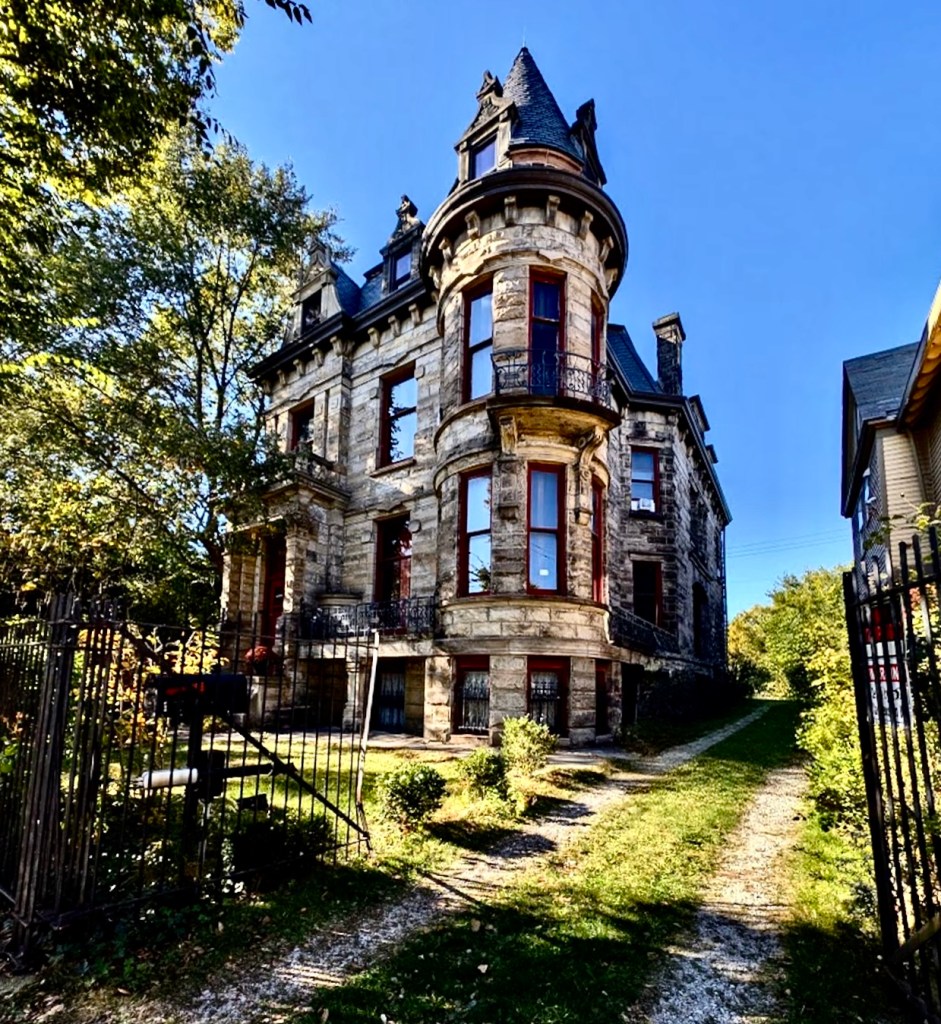
   Franklin Castle was a big stone house built in the early 1880s. It was built where a two-story wood house called Bachelor’s Hall had once stood before being torn down. Bachelor’s Hall was built by the Wolverton brothers. They fought in the Civil War with the Ohio Light Artillery. Only two of the four brothers survived the war. Only one came back to Cleveland. After he died and after Franklin Castle was built visitors reported seeing ghostly soldiers in faded uniforms in the backyard galloping on desperate horses.

   The stone house was built by Hannes Tiedemann, a successful merchant and banker, for his family. His family was his mother, his wife Louise, and six children. His15-year-old daughter Emma died of diabetes. Then his mother Wiebeka died. In the space of no time he buried three more children who died of infectious diseases, two of them of measles. The last children, Dora and August, survived.

   The family lived in their new home on Franklin Blvd. until Louise died in 1895. Soon after the new century dawned Dora and August died. Their father retired to Steinberg, his sprawling summer house on Lake Erie in nearby Lakewood. He passed away in 1908, alone and worn out by tragedy. Franklin Castle became the home of the German Socialist Party. When nobody liked socialists anymore it became the German American League for Culture. Their singing club was very popular, as was the beer garden. Singing in the garden waving a stein was always a good time. Everybody called it Eintracht Hall in those days. 

   After the Germans moved out in 1968 the Romano family moved in. The lady of the house was warned that “this domicile is evil and you shouldn’t have come. You should move out.”  One winter day she sent her children to the top floor to play. When they came down they told their parents about finding a sad little girl in a ragged dress who asked for a cookie to cheer her up.

   They searched the top floor but no child was found. When it happened again they locked the door and kept it locked. They started hearing organ music on weekends, even though there was no organ in the house. Their children woke up in the middle of the night to find their blankets being yanked off them by unseen hands. The family moved out in 1974 and the house was taken over by a man who began offering public tours of “Haunted Franklin Castle.” 

   “What’s so haunted about it?” Emma asked.

   “Lights go on and off by themselves, mirrors suddenly fog up, voices can be heard in empty rooms, and doors fly off their hinge, for starters,” Oliver said.

   “Let’s go inside and see,” Emma said.

   “Does anybody live there?”

   “When I asked dad, he said nobody lives there anymore.”

   When they tried to get inside the house they discovered all the doors were locked. They knocked on the front door. They looked through windows. They knocked on the back door. Nobody answered.

   They were scratching their heads outside the back door when Emma plucked two bobby pins out of her hair. The first pin was going to be a replacement for a key. She bent the rounded end until it was perpendicular to the two free ends. She stuck the rounded end into the key slot. It would act as a handle. She unbent and flattened the second pin, making a long straight pick. She bent one end slightly and slid the bent end into the top half of the keyhole, above the pin she had already inserted into the lock. 

   Emma used her bobby pin to push the pins up, one at a time, until the cylinder was free to turn. She turned it with the first pin she had made into a handle. It was easy as pie. The door opened and they went inside.

   “How did you learn to do that?” Oliver asked.

   “It’s a secret.”

   “No, tell me.”

   “I’ll tell you when you’re 12-years-old like me.”

   The back door suddenly slammed shut. The air got hot and gluey. It  got dark as a tar pit. They heard heavy footsteps.

   “Who has broken into my castle?” the voice of bad juju behind them said.

   Emma almost jumped out of her bobby pins. Oliver, however, kept his nerve. He turned around and said to the eight-foot tall man spirit,  “Can I see your deed to this place?”

   The man spirit looked like a butler from an old movie. He was wearing a black suit with a white dress shirt, black bow tie, and a waistcoat. He had a long face and a nose that was as sharp as a hatchet. 

   “I don’t have a deed,” he said.

   “Then it’s not really your castle, is it?”

   “Well, no, but I live here.”

   “We heard the castle is haunted.”

   “You heard correctly, young man. There are ghosts and phantoms in every room.”

    “Are they mean?”

   “Not all of them, but you would be playing with fire if you thought otherwise.”

   “Can you show us around?”

   “No, I can’t. I have to return to my quarters.”

   “Are they upstairs? Maybe we could follow you.”

   “No, my quarters are in the carriage house in the back.” He pointed through a window. “There is an underground tunnel that runs from the basement, under the rose garden, and to my quarters.”

   Oliver and Emma looked through the window. There wasn’t a rose garden or a carriage house in the backyard. When they turned back to the butler, he wasn’t there anymore. There was a pile of sand where he had been standing.

   “Where did he go?”

   “Maybe he went down to the basement.”

   “Let’s go look.”

   The basement was dark and musty. It had a smell they didn’t recognize. They didn’t know liquor had been made in the basement during Prohibition. A whiskey still was still in a hidden room of the basement, behind a sealed panel in the wall. They saw a trapdoor in the floor.

   “Maybe he went down there,” Emma said.

   When they pulled the trapdoor open, it went nowhere. There wasn’t a tunnel, or anything, just loose-packed dirt. It was a dead-end. Worms were slithering in the dirt.

   “Oh, gross,” Emma said. 

   “I like glow worms the best,” Oliver said.

   “I like gummy worms the best,” Emma said.

   They went back upstairs. There was a large oil painting in the living room above the fireplace. The painting was of Hannes Tiedemann, his wife Louise, their children, Dora and August. Every time Oliver looked at it out of the corner of his eye he thought they were moving their heads and looking at him. He stopped looking out of the corner of his eye. They stopped looking at him.

   There were built-in bookcases on both sides of the fireplace. The shelves were packed with books.  All the books were moldy except for one. The book looked new. It’s title was “The World Without Us.”

   “Let’s go upstairs,” Oliver said.

   The stairs were wide and the handrails were dark brown wood. They felt damp and sticky. There was a small round table on the landing halfway up. There was a recently lit cigar in an ash tray on the table. Smoke like a garden snake curled up to the ceiling.

   “That smells terrible,” Emma said.

   “It smells like old armpits,” Oliver said, stubbing the cigar out.

   When they got to the top of the stairs a wall of fog materialized in front of them. It was a green and yellow fog. Emma took a step into it. She began to lose her way. Oliver pulled her back.

   “I thought I was going to pass out,” she said, rubbing her eyes.

   There were four bedrooms on the second floor. There was a collection of small colored glass bottles full of liquids on a side table in the first of the bedrooms. The bottles were labeled. One said, “This Will Make You Larger.” Another one said, “This Will Make You Smaller.” 

   “It’s like Alice in Wonderland,” Oliver said.

   Only one bottle was made of clear glass. It said, “This Will Make You Disappear.”

   “I could use that on some bullies I know,” Emma said. She reached for the bottle. Just as she was about to put it in her pocket it disappeared. A voice whispered in her ear. “That’s not for you.”

   In another bedroom the outside shutters were loose. They banged against the window frame when the wind blew. When Oliver opened the window and reached for the shutters to secure them, they shut and locked themselves. As soon as he walked away they unlocked themselves and started flapping in the wind again.

   “Things have got a mind of their own in this house,” he said.

   The next bedroom had spiderwebs in every corner. There was fossilized cordwood laid in the fireplace grate. There was a bed and there was a sofa, too, big enough to sleep in. Rotting curtains rustled even though the windows were closed and the air in the room was fetid. There was a diary on the bedside table.

   “Let’s take a look at this book,” Emma said. “Maybe it will tell us something about this house.”

   When they opened the book, however, as they flipped the pages they crumbled into yellow fragments. A shred of a page whispered, “Whoever reads my journal, beware of the creature below.” The yellow fragments sprinkled themselves all over the floor. When Oliver and Emma turned to leave, the fragments gathered themselves and  transformed into an arm that reached for their legs. The fingers were long as carrots. They ran out of the room.

   When they opened the door of the last bedroom it was inky black inside, even though the curtains were pulled back and they could see through the window that it was sunny and bright outside.

   “Let’s not go in this room,” Emma said.

   “This house is creepy but it isn’t really any more creepy than that abandoned amusement park in Chippewa Lake dad stopped at last year,” Oliver said. “The one where he said they filmed the movie ‘Closed for the Season.’ The Ferris wheel, remember how it was all rusty, and the Fun House, some of the old walls were still there, painted in Day-Glo green, it was kind of sad.”

   “It was closed forever,” Emma said.

   “That’s a long time,” Oliver said.

   They took the stairs to the top floor ballroom. It was put in by Hannes Tiedemann to cheer up his wife, Louise, after the tragedies the family suffered. He thought she might dance her sorrows away. The ballroom was large, stretching the length of the house. When it was added to the house so were turrets and gargoyles. It was what made the house look like a castle.

   The ballroom was empty. They walked the length of it, their footsteps echoing behind them. The echo was behind time, lagging a few seconds behind their footsteps. When they turned around to go back the way they had come the echo was gone. There was a specter blocking their way. It was a skeleton wearing a black hooded cloak and carrying a scythe. It was the Grim Reaper.

   “Well, well,” the Grim Reaper said. “What have we got here, Hansel and Gretel?” He grinned looking down on them and then laughed like a hen with hiccups.

   “Oh, oh,” Emma said, looking him up and down. She didn’t like what she was seeing or hearing. Who laughs like a hen with hiccups?

   “No, we’re not Hansel and Gretel,” Oliver said. “Who do you think you are? It’s not Halloween. And what’s with the laugh?”

   “Who do I think I am? I am the Prince of Darkness, Lord of the Flies, and Old Nick all wrapped up in one. I am Scratch and that’s no Halloween nonsense. I am the Grim Reaper.”

   “All right, Mr. Grim, but what’s with the laugh?”

   “I’ve got something in my craw I just can’t shake.”

   “Would that be the Angel of Life?”

   “Never you mind, young man.”

   “Why are you calling us Hansel and Gretel? Do you think you are going to eat us?”

   “I ask the questions around here,” the Grim Reaper said. “What are you doing in this castle?”

   “We have a professional interest in Franklin Castle,” Oliver said. “We’re the Monster Hunters of Lake County.”

   “Have you lost your way? This is Cuyahoga County. On top of that, you’re nothing but children. What kind of professional interest could you possibly have in anything? Are you half-pints even in school?”

   “I just started middle school, I’ll have you know,” Emma said.

   She had seen the Grim Reaper in a history book, a long-haired skeletal figure from the 14th century wearing wings and carrying a scythe. His black clothing went back to the early 19th century, when people started wearing  black at funerals. The full Monty, hooded skeleton, black robe, and scythe, became common around the mid-19th century. That’s what he looked like in “A Christmas Carol” by Charles Dickens, wearing a dark cloak with only a single gesturing hand to be seen. 

   “People fear me, you know,” the Grim Reaper said.

   “I once heard a song called ’Don’t Fear the Reaper,’” Oliver said.

   “All our times have come here, but now they’re gone, seasons don’t fear the reaper,
nor do the wind, the sun, or the rain.”

   “That was some tough talk by the Blue Oyster Cult,” the Grim Reaper said. “Do you know what their new album last year was called?”

   “No.” 

   “It was called ‘Ghost Stories.’ That’s what they’re going to be sooner or later. I saw one of their shows. After the show I made a joke, asking them, ‘What did the chicken say to the Grim Reaper?’ The drummer was like you. He asked me why I was asking. I told him because I was death myself.”

   “What did he say?” 

   “He said, ‘I’ll talk louder then.’ He was half deaf from his own loud music and misunderstood what I said.”

   “What did the chicken say, anyway?”

   “I should have looked both ways,” the Grim Reaper chuckled.

   “What’s with that stick with the curved knife at the bottom?” Oliver asked.

   “It’s not a stick and it’s not a knife. It’s a scythe. It’s for harvesting souls like a farmer harvests crops.”

   “Farmers use tractors, not that scythe thing.”

   “The scythe is what farmers used to work their fields with.”

   “Well, they don’t use them anymore. You should get a tractor.”

   “That’s not the point,” the Grim Reaper said, annoyed. “It’s a symbol.”

   “Symbols don’t put food on the table,” Emma said. “Dad has to go to work every day and mom just got a job so we will have money for college. We are buying a new house soon, too. Does the FBI know you carry that scythe thing around? It looks like a deadly weapon. Is it legal?”

   The Grim Reaper was not used to being peppered with questions. “Why me, why now?” is what he sometimes heard, although most people were scared stiff and didn’t say much of anything. Whenever they asked he always said, “Life is for the living but then I arrive with my scythe and you are done with life. Then they throw dirt in your face. Then the worms eat you. Be glad it happens in that order.”

   “Did you hear what I asked you, Mr. Grim?” Emma asked. “Is that thing legal?”

   The Grim Reaper was losing his patience. He was normally very patient. Life spans, however, had been increasing century by century and appointed hours had become long in coming. The trend was taxing him. These children questioning his tools of the trade were irksome. Their appointed hour wasn’t close at hand, but if they kept it up he might lose his composure and go after them.

   “You should put that thing away and get some nicer clothes,” Emma said. “That robe has  got moth holes. It’s really dirty, too. Do you ever wash it?”

   That was all the Grim Reaper could stand. He raised his scythe and swung at Emma. She jumped away from the swing. She was a quick girl on her feet.

   “Hey, what do you think you’re doing?” Oliver shouted. “Leave my sister alone.”

   The Grim Reaper swung his scythe at Oliver, who dodged  the sharp blade, grabbed Emma’s hand, and pulled her towards the door. The Grim Reaper weas fuming. He never swung and missed. Was he getting old and feeble? That couldn’t be. He was ageless, after all.

   “This house has thirteen fireplaces,” he shouted. “ When I catch you I will burn you both in all of them.”

   He ran after Oliver and Emma, his bones clacking and the scythe hissing. He wasn’t fast enough. Oliver and Emma pushed the ballroom doors open and ran down the stairs. The Grim Reaper followed, making up time by straddling the handrail and sliding down it. 

   Oliver and Emma ran past the reading room on the third floor where a book was reading itself. It was a one thousand page weepie. Tears were splashing onto the pages. They ran past Hannes Tiedemann’s office on the second floor. The ledgers in the office had long since turned to yellow dust.

   By the time they got to the ground floor the Grim Reaper was hard on their heels. A voice called out to them, “Come this way.” It was the ghost of Hannes Tiedemann. “Get in this barrel,” he said, pointing to a barrel. They got in it. Hannes Tiedemann fitted a circular lid on top of the barrel.

   After coming from Germany as a boy Hannes Tiedemann had worked as an apprentice barrel maker before getting into wholesale groceries and later into banking. He liked money well enough, but never lost his fondness for barrels.

   The Grim Reaper searched the ground floor, the foyer, parlor, and dining room. He searched the toilet room. He came up empty. Gnashing his teeth he went up and came back down the servant’s stairwell. He was standing in the foyer when he noticed his reflection in a full-length mirror. Looking himself over he thought maybe the brat was right. He was looking shabby. He needed a new robe. He checked his wallet. He had enough cash to get something nice. He went out the front door and disappeared down Franklin Ave. towards the stores on W. 25th St.

   When Oliver and Emma were sure he was gone they got out of the barrel and ran outside to where they had left their Lime e-scooter. It wouldn’t start, however. It had timed out. Neither of them had a credit card. Neither of them had ever had a credit card. They pushed the e-scooter off the sidewalk and leaned it against the wrought-iron fence surrounding the house.

   It was a long walk back to St. Ignatius High School. They were very tired by the time they got there. Their father put them in the back seat of their Jeep SUV. He drove north to Lake Erie and took a right. He took the Shoreway back to Lake County. Oliver and Emma slept like the dead all the way home.

Ed Staskus posts monthly on 147 Stanley Street  http://www.147stanleystreet.com, Made in Cleveland http://www.clevelandohiodaybook.com, Down East http://www.redroadpei.com, and Lithuanian Journal http://www.lithuanianjournal.com. To get the site’s monthly feature in your in-box click on “Follow.”

“Bomb City” by Ed Staskus

“A police procedural when the Rust Belt was a mean street.” Sam Winchell, Beyond Books

Available on Amazon: https://www.amazon.com/dp/B0F1LM1WF9/ref=sr_1_1?crid=2MYAQAOZIC2U9&dib=eyJ2IjoiMSJ9.hTm7BGbiQbSe5ZapFwYPPfcwOpTe-Vdg6VLE4aGyTyk.Z0R-VNBWWEcvKcNaO9LdCOUnNIOOXgvYkRS_FXiXuHk&dib_tag=se&keywords=bomb+city+ed+status&qid=1742136726&sprefix=bomb+city+ed+staskus%2Caps%2C84&sr=8-1

Cleveland, Ohio 1975. The John Scalish Crime Family and Danny Greene’s Irish Mob are at war. Car bombs are the weapon of choice. Two police detectives are assigned to find the bomb makers. Revenge is always personal. It gets personal.

A Crying of Lot 49 Publication
Born and Bred

By Ed Staskus

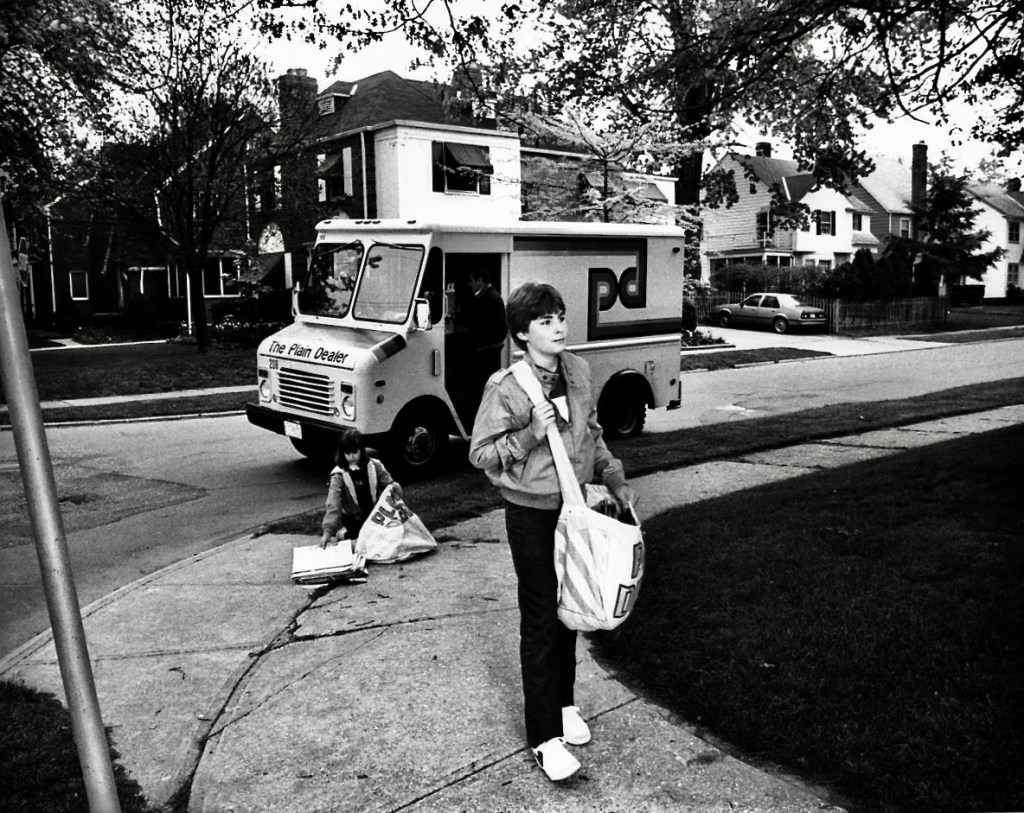
   Maggie Campbell was a Bay Brat, which means she grew up in Bay Village, Ohio, where the well-off live west of Cleveland, while the not so-well-off live back east in Cleveland. She lived there her whole life growing up. When she was a girl, she picked up every lost bird and squirrel, every lost cat and dog, and every injured anything still alive and brought it home to protect it.

   She was an animal lover from the get-go. She got it partly when she was born, in the blood, partly from her dad, Fred, but not from her mom. Alma never liked any of the animals they ever had in the house basement garage backyard.

   Her parents met at Lycoming College in Williamsport, Pennsylvania, a few hours from Philadelphia. Her grandparents on her dad’s side had moved from Ohio to Philadelphia a few years earlier and enrolled in college there after high school. Alma was working in the town library, which is how they met. He fell head over heels for her, swept her off her feet, or at least he thought so, and they got married.    

   “We’re out of here,” is what he said the minute they got married. They moved right back to Cleveland. Even though they were married for more than forty years it might have been the worst thing either of them ever did. But Fred was stubborn, and Alma could be mean as a junkyard dog.

   Maggie had a mom who didn’t love her dad, and a dad who was frustrated about it, and the way he tried to make his wife happy was to rough up their kids. So, it was a tough childhood. Either you were being totally ignored or you were being roughed up.

   There were four of them. First, there was Elaine, then two years later Maggie, and then Bonnie hard on her heels, and last, three years later, Brad. Alma always said Fred tricked her four times. He zipped it up and from then on kept his thoughts to himself.

   He was from Cleveland, from the west side, where he grew up almost rich for his time. Alma was from Jersey Shore, just a few miles from Williamsport, where she grew up poor. Jersey Shore isn’t anywhere near New Jersey, the Jersey shoreline, and the shoreline it had didn’t live up to the name. There used to be silk mills and cigar factories in Jersey Shore. Later, factories made steel rails for train tracks there.

   During the Depression Maggie’s paternal grandfather was the only teenager in his high school who had a car. He used to follow her grandmother down the street trying to get her to come in his car with him, saying he wanted to help carry her books, so along the way what happened was they got cozy and got married.

   Her grandfather in Jersey Shore had three jobs the minute he stopped being a teenager. He was a coal miner, a school bus driver, and a milkman, but his family still stayed in the dumps. They were too poor to paint but too proud to whitewash. Even though they were always short they built their own house on the Susquehanna River. Maggie didn’t know how they got it built since they were strapped for hard cash most of the time.

   The river was their front yard. Susquehanna means Oyster River and it was on the Susquehanna where the Mormons say they got their holy orders delivered to them by divine beings. It was a big comfortable house. It’s still standing, although it’s not been taken care of, so it’s falling apart fast.

   Her grandmother lived in the house into her 80s, but then sold it and moved into a trailer, in a trailer park in the mountains above Jersey Shore. She started believing people in the other trailers were trying to shoot her with laser guns. She slept wrapped up in foam rubber holding an umbrella over her head for protection. Alma never wanted to talk about her mom because she thought she was crazy, and a Jesus freak to boot.

   Maggie didn’t know her Jersey Shore grandfather. He died young. He had arthritis from tip to toe, and it finished him off. It didn’t help working underground coal mining. She knew her grandmother well enough. Whenever her sisters and she visited her, she taught them how to pull taffy and fudge. They played with her paper dolls. She didn’t have any real dolls. They sat on the front porch in the afternoon and waited for the bean truck.

   “Before dinnertime she sent my older sisters to the side of the road. When the bean truck, or sometimes the vegetable truck, went by on the unpaved road beans bounced off the back of it and they would run and gather them up. My grandmother cooked them for dinner. If no beans fell off the truck, there was no dinner, although she usually had a little something else in the house.” Most of the time it was something cold she had canned months earlier.

   Fred went to Upper Darby High School, starting when he was a sophomore. His parents moved him to Philadelphia from Cleveland, and he never stopped saying he hated it. He was a Cleveland Browns fan and wore their colors, so he got into fights every day with the other kids who were Philadelphia Eagles fans.

   “My dad liked telling us stories when we were growing up, like the one about how one day he and his friends went to the second story of their high school and jumped up and down all at once all together until the second floor fell in on the first floor.” The school’s mascot is a lion, but when Fred was there it was a court jester.

   Fred’s parents were from Akron and lived in Lakewood for a long time. They had to move when the new I-90 highway was being built. It was called the “Main Street of Northern Ohio.” When they were growing up Fred would drive them to a bridge over the highway and show them the exact spot below the bridge where their house used to be.

   It was when they had to sell the house to the state that they moved to Philadelphia. After Fred and Alma came back, they lived in Lakewood in a rented house for a few years. Maggie’s sister Elaine was born there. The rest of them made the scene in Bay Village. The family had moved to a short cul-de-sac, five blocks south of Lake Erie. Her dad designed the house, and it was built just the way he wanted it. He died when she was thirty-three years old. The next thing she did was get married to Steve de Luca.

   The crow’s nest was where Maggie grew close to Brad, who when he was small fry looked just like Bamm Bamm in the Flintstones cartoons. They even called him Bamm Bamm, although after he got his drum set, they called him Boom Boom. Brad brought home a drum set somebody had thrown out on their tree lawn and set it up in the basement. He taught himself how to play. He called himself Ginger Boom after Ginger Baker, his favorite drummer. He had thrown down the gauntlet. After he did no animal nor human would go down to the basement. It was too noisy, to begin with, and damp as his underarms, besides.

   They all had our own rooms, although Brad and Maggie shared a room because the house was a room short. Her sisters had separate bedrooms down the half-story stairway from them, and her parents were at the other end of the hallway. They lived in the crow’s nest until Elaine moved out and got married and Maggie finally got her own room.

   Maggie was Brad’s number one protector when he was growing up, like she was with all the neighborhood’s lost cats and dogs. She and Brad sold bananas, bread and butter sandwiches, and hard-boiled eggs on their front lawn whenever their mom wasn’t looking. They ran to Bracken Way with money in their hands when they heard Uncle Marty’s Ice Cream truck coming.

   But Maggie could never protect Brad from Coco, their poodle, who bit and tore his diapers off when he was little. He could never crawl away fast enough, no matter how fast he scurried on his hands and knees. The dog was quick as the devil and cut him off.

   Sometimes Maggie didn’t try to stop Coco, even if she could have. She had some of her mom’s tough love in her. Other times Brad had done something she didn’t like, and it was just his tough luck that Coco was on the rampage. She could be a brat when she had to be.

Ed Staskus posts monthly on 147 Stanley Street  http://www.147stanleystreet.com, Made in Cleveland http://www.clevelandohiodaybook.com, Down East http://www.redroadpei.com, and Lithuanian Journal http://www.lithuanianjournal.com. To get the site’s monthly feature in your in-box click on “Follow.”

“Cross Walk” by Ed Staskus

“A Cold War thriller that captures the vibe of mid-century NYC.” Sam Winchell, Beyond Books

Available on Amazonhttps://www.amazon.com/dp/B0CRPSFPKP

Late summer, New York City, 1956. The Mob on the make and the streets full of menace. President Eisenhower on his way to Brooklyn for the opening game of the World Series. A killer waits in the wings. Stan Riddman, a private eye working out of Hell’s Kitchen, scares up the shadows looking for a straight answer.

A Crying of Lot 49 Publication

Career Day

By Ed Staskus

   All through my junior and senior years at St. Joseph High School, which was within walking distance of where we lived, my father pressed me to focus on something that would lead to a career. He was big on the idea. He was himself a career man. During those two years I told him I didn’t know what I wanted to focus on. I didn’t tell him I wasn’t enthralled by guidance counselors. I was reading Charles Baudelaire, a mid-19th century French prose-poet, who had  told his parents, “I don’t feel I have a vocation for anything.”

   I wasn’t especially interested in seeing my picture on a baseball card or a wanted poster.  Photographs are full of lies and labels. I wanted to take my own picture and tuck it away somewhere private.

   I read Charles Baudelaire’s book “The Flowers of Evil” the winter of my senior year at St. Joseph’s. It wasn’t assigned reading, not by far. St. Joseph’s was a traditional college preparatory high school, focusing on core academic subjects like math and science, social studies, and English. Religious instruction was a required feature of every day. Our teachers, the Marianists, brothers of the Society of Mary, made sure it was an everyday thing. There was no arguing the divine with them. There were vocational courses, as well, but my father was determined that I go to college. He didn’t want to see me repairing cars or working a tool and die press.

   My favorite class was English. My favorite thing to do was read books. I always did my homework. I read assigned books like “The Great Gatsby” and “Of Mice and Men” and “To Kill a Mockingbird.” I wrote sincere essays and aced tests. I neglected my other classes, reading books that weren’t assigned. I read “Lord of the Flies” and “Nineteen Eighty-Four” and “The Catcher in the Rye.”

   “The Catcher in the Rye” wasn’t banned at St. Joseph’s, but reading it was strongly discouraged. The official explanation was we should stick to our program of studies. The unofficial explanation was the book was depraved, full of vulgar language, sexual references, and anti-establishment themes. The Marianists were concerned about the book’s morality, or lack of it.

   After graduation I opted to attend Cleveland State University. It was close to hand, a twenty minute bus ride away, and affordable. The school had been established as a state university in 1964, taking over the buildings, faculty, and curriculum of Fenn College, a private engineering and business school of several thousand students that had been founded in 1929.

   I spent my freshman year at Cleveland State University the same way I had spent my junior and senior years at St. Joseph’s, attending English classes without fail and neglecting my other classes. At the conclusion of the school year my father sat me down and read me the riot act. It led to a stinging argument, but in the end, since I was still living in my parent’s house and my father was paying part of my tuition, I agreed to participate in a kind of career day scheduled for the next month in the Flats, the city’s industrial valley.

   Most of my father’s friends were Lithuanians and most of them were professionals. They were doctors, lawyers, and engineers. My father was a certified public accountant. One of his friends was a mechanical engineer. He had a son my age who was majoring in engineering at Cleveland State University. One of his classes had a field trip to the Flats planned. They saved a seat for me.

   The day of the field trip I waited on our front steps for my ride. It was June 22, 1969, early on a Sunday morning. The factories in the Flats never closed, but slowed down somewhat on Sundays, which made it less demanding to accommodate college students wandering around. When my ride came down our street I saw it a mile away, it being a chrome yellow color. it was a 1965 Ford Econoline Club Wagon. It didn’t have a front end to speak of but there were plenty of windows. Half of the  family van was windows. There were two bucket seats up front and three rows of bench seating in the back. My father’s friend was driving and there were six engineering students in the van. They had saved the front passenger bucket for me. It was a lonesome seat, but I wasn’t one of the rank and file, anyway, so I didn’t mind.

   We got on I-90 and drove to the Flats. There was hardly any traffic. When we got downtown we drove into the industrial valley. It was a warm and sunny day. It was more warm and less sunny in the valley. The air smelled like sewage and rotten eggs. The A. W. Stadler Rendering Plant near the Harvard Ave. Bridge added the odor of rotting animal matter to the stench.

   The Flats were located along the Cuyahoga River where it snaked through the north side of the city and drained into Lake Erie. It is bottom land there, the floodplain for the river. The earliest settlers in Cleveland settled in the floodplain, but it was swampy and they soon moved to higher ground. The Ohio & Erie Canal spurred lake shipping in the 1830s and rail lines spurred commercial growth in the 1860s. The Flats became the cradle of heavy industry in Cleveland. Business boomed exponentially. After 1870 the Flats teemed with foundries, iron furnaces, rolling mills, oil refineries, and chemical factories. The river was where they dumped their waste. It was their liquid landfill.

   A century later the Flats was dank, begrimed, and very polluted. Nobody went there other than to work in the warehouses and steel mills. There were dive bars like the Harbor Inn and the Flat Iron that served greasy food and cheap booze to working men. The air was bad and the waterway was worse. No one had dared to swim in the Cuyahoga River for decades. A journalist described braving the water as “no person drowns in it, they decay.” All the fish in the reach from Akron to Cleveland had long ago died. Nothing except Japanese movie monsters could survive in the thick sludge that had once been water

   “The river was a scary thing,” Tim Donovan explained. He was a high school graduate that summer, saving up for college, working as a hatch tender unloading ore carriers. Dead rats floated past the dockside cranes, bloated to the size of dogs. “There was a general rule that if you fell in, God forbid, you would immediately go to the hospital.”

    We toured Republic Steel and Jones & Laughlin Steel. They were colossal enterprises. We could have saved time by just going to one of them since they were so much alike. There was an unbroken roar of loud machinery. The fires, furnaces, and molten metal made the factories hot. Dust and black soot covered everything. The gasses in the air didn’t make for garden variety air pollution. Breathing as we walked from one end to the other end of the factories was like breathing something poisonous.

   The reason the engineering students were on the field trip was to help them bridge the gap between classroom theory and real-world application. Manufacturing steel involved many engineering disciplines. Seeing it happen in real time gave them a chance to see complex machinery involved in large-scale processes. They got to see first-hand how their classes in mechanical design and material science applied to the steel industry. It was eye-opening to them, and me, too. I found out there and then that I wasn’t prepared be an engineer.

   It was mid-day when the field trip wrapped up. We piled back into the Ford Econoline Club Wagon, drove in one direction, and then another direction. The through streets in the Flats generally followed the Cuyahoga River, running parallel to its banks. The side streets connected to surrounding neighborhoods like Ohio City and Tremont. Nonetheless, we got lost. We finally found ourselves on the Campbell Rd. Bridge, 

   There was a Plymouth Barracuda at a dead stop ahead of us on the bridge. We stopped and waited. A police car, its lights flashing, pulled up behind us. We stayed sandwiched where we were between them.

   “What’s going on?” one of the engineering students asked.

   “There seems to be a small fire down there somewhere,” our driver parent said, peering over the dashboard. 

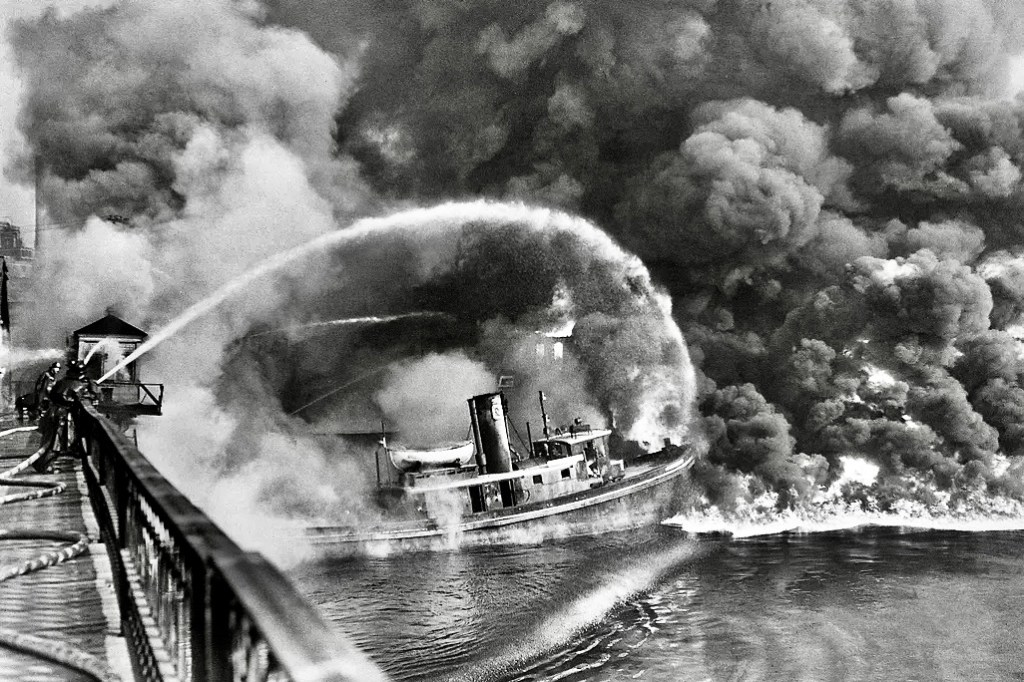
   There was a sudden whoosh. Oily clouds of heavy black smoke rose up. We got out of the family van and went to the railing to get a better look. The smoke became a sky-high wall obscuring everything beyond the opposite bank. A fire department tanker truck crept onto the bridge. A fireboat by the name of Anthony J. Celebrezze made its way under the bridge to the wall of smoke. 

   What was going on was the Cuyahoga River was on fire.  It wasn’t the first time it had caught fire. It had happened a dozen times since 1868. This was the thirteenth time it caught fire. A flare tossed from an overpassing train had ignited the  petroleum-covered water. 

   The worst of the earlier fires happened in 1952 when oil and industrial debris on the river’s surface ignited. The fire destroyed three tugboats, three buildings, and some ship repair shops. It damaged a railroad bridge. It caused over one and a half million dollars’ worth of damage. Nobody in Cleveland was shocked by the river catching fire. It didn’t flow as much as ooze. Everybody was resigned to the city being one of the most polluted cities in the United States. “It’s the cost of doing business,” city fathers and business moguls said.

   The fireboat crept close to the blaze, began drawing water directly from the river, and used its deck guns to try to smother the flames. It was like pouring gasoline on gasoline. The flames leapt higher. Three fire battalions drew water from hydrants and discharged it onto the fire from the river bank. They were far more effective. 

   We watched from the deck of the bridge, standing in a cluster behind a railing. The summer breeze was blowing our way, but from behind us, so we weren’t smothered by the smoke. It was still noxious. It was sharp and acrid, like burnt toast that had been buttered in sulfur compounds. We got back into the Ford Econoline Club Wagon and rolled up the windows. It didn’t help all that much.

   The inferno lasted thirty minutes. Once it was out a policeman waved us forward and we drove away. We drove along the river. As we went the water became orange from the pickling acid used by the steel mills. We got lost again and ended up on the Jennings Rd. Bridge, which connected Abbey Ave. to W. 25th St. Our driving parent knew W. 25th St. well because he shopped for fruits and vegetables at the West Side Market. He knew how to get home from there. Crossing the bridge I looked down. There was a slaughterhouse below us. I could see blood and animal parts streaming out of  outfalls and into the Cuyahoga River.

   “That was amazing,” one of the engineering students said.

   “Who ever heard of water catching fire?” another one said. “Somebody should do something about it.”

   “And put us out of a job?” a third one said.

   Once I got home I threw my clothes down the clothes chute and took a shower to wash away the smell. I put on a clean pair of jeans and a t-shirt. I combed my hair. My father was taking a Sunday late afternoon nap in the backyard. He woke up when I threw myself down in a lawn chair.

   “How was your career day?” he asked.

   “We toured a couple of steel mills and saw the Cuyahoga River catch fire,” I said.

   He seemed unfazed by the news. He had lived through World War Two as a teenager on his own. He had seen his share of bombs and fires. He fled Lithuania in 1944 and spent five years in and out of refugee camps, working black markets until he found steady work with a relief organization near Nuremberg. When he finally made it to North America he ended up in Canada, where he worked digging up nickel and copper in the Sudbury ore basin for eight years. We had been in the United States the past ten years.

   “Have you thought about getting into engineering?”  he asked.

   “I don’t think I have a talent for engineering, although I understand engineers make the world go round, at least our modern world,” I said. “But you’ve got to watch out for them. They start by making sewing machines and end with crazy hellfire.”

Ed Staskus posts monthly on 147 Stanley Street  http://www.147stanleystreet.com, Made in Cleveland http://www.clevelandohiodaybook.com, Down East http://www.redroadpei.com, and Lithuanian Journal http://www.lithuanianjournal.com. To get the site’s monthly feature in your in-box click on “Follow.”

“Cross Walk” by Ed Staskus

“A Cold War thriller that captures the vibe of mid-century NYC.” Sam Winchell, Beyond Books

Available on Amazonhttps://www.amazon.com/dp/B0CRPSFPKP

Late summer, New York City, 1956. The Mob on the make and the streets full of menace. President Eisenhower on his way to Brooklyn for the opening game of the World Series. A killer waits in the wings. Stan Riddman, a private eye working out of Hell’s Kitchen, scares up the shadows looking for a straight answer.

A Crying of Lot 49 Publication

Maybe Later Baby

By Ed Staskus

   “The end is always near,” Greg Smith said, sinking back into the firm as Jell-O bench seat. Flying bugs recently alive littered our windshield. One of them left a big yellow blob behind him the instant he hit the glass. It was a fine summer day. Jimi Hendrix’s song “Stone Free” was playing on the car radio.

   Greg’s driving hand was easy on the steering wheel. His other hand was wiggling in the outside air. He was driving well enough to keep us on the road, but his eyes were like pinwheels. The magic mushroom he had popped into his mouth a half hour earlier was working its magic. I couldn’t tell him to slow down because he was going slower than a horse-drawn buggy. I reached for the seatbelt, anyway. When I did I found out the top drop Chevrolet Impala SS didn’t have seatbelts. 

   I had taken a Greyhound bus from Cleveland down the hillbilly highway and hooked up with my friend Greg in Athens. It wasn’t Greece. It was southern Ohio in the northern Appalachians. I called him Jonesy for fun, even though he didn’t think it was funny. “I don’t like glibness,” he complained like an offended grade school teacher.

   SS stood for Super Sport. There was nothing super about the car anymore, which came off the assembly line in 1961, except for the engine. It was still super when it had to be. The rocker panels were rusting out, the front of the hood was gashed, and the tires were bald as baloney skins. The car was Roman Red on the outside while the interior was scuffed black leather. I reached for the grab bar attached to the padded dashboard.

   “Do you know this car was built by union labor right here in the United States?” Greg asked, apropos of the Japanese and German cars we had been seeing here and there.

   “No, I didn’t know that,” I said.

   “It’s got a V-8 engine. One of my uncles might have built it.”

   “Is that right? By the way, what do you mean the end is always near?”

   “Like they say,” he said, “the future’s uncertain and the end is always near.”

   At the moment the Chevy Impala SS was running on one of the V-8’s and none of Greg’s car-making relatives were in sight. What was in sight was the future. There was a flashing red light behind us. It was the kind of light that always looks makes you feel blue. The Meigs County policeman didn’t have any trouble getting on our tail. He had some trouble pulling us over, however, even though the road was straight and narrow as a preacher. The manual steering took several turns of the steering wheel to go from lock to lock. In the state he was in it took Greg a few minutes and a mile-or-so to master the mechanics of pulling off onto the shoulder.

   The policeman didn’t bother asking for his driver’s license. “Step out of the car, son, and let me smell your breath,” he said.

    Greg didn’t like being called son. He scowled patting himself down for his wallet. He huffed and puffed in the policeman’s direction.

   “You smell all right,” the policeman said. “It don’t seem like you been drinking or smoking stinkweed.” The Chevy had a vacuum powered ash tray that sucked ashes to a container in the trunk. “Why are you going so slow when you got that power horse under the hood?”

   “I know this road doesn’t go anywhere but I’m looking for the end of it,” Greg said. “I don’t want to miss it.” The policeman wasn’t fazed by the nonsense. “It don’t go nowhere but it always brings you back again,” he said. Greg was flummoxed for a minute. The policeman looked the Chevy Impala SS up and down. “This is the car the Beach Boys wrote a song about, son.”

   The song was a big hit in its day. “Nobody can catch her, nothing can touch my 409, giddy up, giddy up, my four speed dual quad 409,” Brian Wilson sang in his big falsetto while the rest of the boys layered the harmonies. The fired-up 409 was fitted with a 4-barrel carburetor and a solid lifter camshaft. The pistons were made from forged aluminum. The heads and engine block were made from cast-iron.

   “Those were the days, boys. Make no mistake, that Impala is a real fine car. Try to put some giddy up into your driving. And keep it on the yellow line.” He got back into his black and white Dodge Coronet patrol car and u-turned, going the way he had come. He drove away in good order.

   I was along for the ride on Greg’s ride that day. I had spent the spring, summer, and fall of the previous year in a nearby town called Carpenter living with Virginia Sustarsic in an abandoned general store. She wasn’t my girlfriend, but we got along, even though she was a dyed in the wool hippie and I wasn’t. She rolled her homegrown delicately and deliberately. We kept two goats, gleaned plenty of food, and brewed our own beer. I drank most of the beer. A stray kitten made us his crash pad. The town wasn’t a town so much as a whistle stop. The railroad had long since abandoned the place, though. There were maybe a dozen residents, including us. There were dust balls in all the corners of the crossroad. At night every star in the universe twinkled in the nighttime sky.

   Carpenter was in Meigs County. It was named after Return Meigs, Jr., who was the fourth governor of Ohio. The county is on the Appalachian Plateau in the southeast corner of the state. The Shade River and Leading Creek drain into the Ohio River. Leading Creek ran right through Carpenter. In the 1970s the county’s population was less than 20,000. As far as I could tell there were no Asians, Native Americans, or African Americans anywhere. There were trailer trash on every other hillside.

   Greg was a friend of John McGraw’s, who was Virginia’s on-again off-again boyfriend back home. They both lived on the bohemian near east side of downtown, near Cleveland State University. John was a part-time writer and drank whiskey straight from the bottle. Greg came from a more polite class and drank from a glass. He and John had planned on sight-seeing Meigs County, but at the last minute John bowed out. Greg went anyway, cruising all the way from one end of the state to the other in his big Chevy SS.

   Virginia dressed like it was still the Summer of Love while John more like the Age of Beatniks had never ended. Greg wasn’t any better off than them, living half on and half off the American Dream, but he dressed like a preppy. He read the classics. He was studying Latin so he could read Ovid and Seneca in the original. Nobody ever suspected he kept magic mushrooms in his wallet.

   Something came over him the minute the policeman was out of sight. He fired up the Chevy SS. He spun gravel getting back on the asphalt. The next minute we were doing eighty in a forty. The Doobie Brothers came on the radio belting out “Rockin’ Down the Highway.” I took a peek in the rearview. There was nobody behind us. I looked through the windshield at what was in front of us. All the danger was in front of us.

   “We should maybe slow down,” I calmly suggested as loud as I could. 

   The Chevy SS was a four on the floor. She wasn’t good on gas and burned some oil. Greg picked up speed. We were doing a hundred in no time. There were no more gears to shift up into. His eyes weren’t pinwheels anymore. They glinted like icepicks. He leaned over the steering wheel. The car wasn’t sloppy, nor was Greg’s handling of it sloppy, but we were headed for trouble. We were blasting down a back road. It was cracked and rough and more gravel than not. Meigs County didn’t have the tax base to keep its roads in any kind of Daytona 500 shape.

    “I’m not asking for a miracle, Lord, just a little bit of luck will do,” I whispered.

   “Every minute counts,” Greg shouted above the wind noise.

   “Keep your eyes on the road,” I shouted back. “You never can tell what’s around the corner.”

   He waved at the outdoors with his left arm. Southeastern Ohio on a sunny day in the summer is beautiful. When we roared around a blind curve there wasn’t anything there, to my relief, until there suddenly was. It was a roadhouse with some cars and pick-ups in the front, which was a small parking lot full of potholes. The sign said Frank’s Roadhouse. There were worn-out antlers nailed to the outside wall above the front windows. We pulled in, skidding in three or four different directions. A long-tailed weasel ran the other way. There were half a dozen bungalows in the back.

   Inside there was a bar, a kitchen, some tables, a dance floor, a riser protected by chicken wire, and a pool table. A man and a woman were having mashed potatoes with pulled pork at one of the tables. A bottle of BBQ sauce stood at the ready between their plates. There was some action going on at the pool table but none on the dance floor. Before I knew it Greg had found unexpected action at the bar, where a cute brunette was sitting, a lowball glass half full of red wine at her elbow and a paperback book in front of her.

   There was an oblong mirror on the wall behind the bar. It was too smudged to see into. There was a hand-written warning on a greasy piece of cardboard below it. It said, “Don’t eat the big white mint!” I didn’t ask what it meant. I didn’t want to know. What’s a simple man to do? I looked around for something to do. I put a dollar on the lip of the pool table marking my turn in line. There were two men playing nine ball. It was the middle of the day on a Thursday. Neither of them was on union soil. Neither of them was being especially efficient. There were seven or eight bottles of Burger Beer on a small round table behind them.

   One of the men looked me up and down. “I’m a pretty big man around these parts,” he said, flashing a Mighty Mouse grin. He had sharp yellow teeth. He was shorter than me, but I knew what he meant. “I thought you’d be bigger,” I said. He didn’t laugh. He had the sense of humor of a circus strongman. The other man laughed his head off. My man broke the rack. He was no Minnesota Fats. When my turn came I ran the rack and took my dollar back. I collected a dollar from the local yokel. He tried his luck two more times and paid me two more dollars. He didn’t know, and I didn’t tell him, that I spent more time than I wanted to admit, even to myself, shooting snooker at Joe Tuma’s Pool Hall back in Cleveland.

   I bought them both beers, they clapped me on the back, the circus strongman harder than he needed to, and I went back to the bar, joining my friend and his new friend. He wasn’t paying any attention to her book. He gave me a wink, suggesting the main drag from the eye to the heart doesn’t go through the intellect, or words to that effect.

   Her name was Annie. She was a third-year student at Ohio University in Athens, 20-some miles to the northwest of where we were. She was majoring in English. She wasn’t enrolled in classes that summer but had stayed in Athens instead of going home to Cincinnati. She spent her spare time exploring. She had found Frank’s Roadhouse by accident, liked the looks of it, and stopped in for the afternoon.

   “What do you like about this dump?” I asked.

   “It looks real,” she said.

   I was willing to grant her that. When the bartender approached I ordered a Vernors Ginger Soda. Between the earlier psychedelics and shots of roadhouse whiskey stirring up my tour guide, I knew one of us had to stay on the wagon. 

   “Who is Frank,” I asked the bartender. 

   “There ain’t no Frank, at least not no more,” he said. 

   “What happened to him?” 

   “Nobody knows,” he said.

    The middle of nowhere is as good a place to disappear as any.

   I reminded Greg we had promised our farmhouse friends where we were staying we would stop at the grocery store in Pomeroy and pick up milk, cheese, and toilet paper. Toilet paper was like gold where they lived. Greg’s eyes had gone soft and fuzzy in the meantime. He needed reminding. I had to remind him twice. He finally slid off the bar stool glowing like a full moon in a clear sky.

   Annie followed us out to the Chevy SS. “I like your car,” she said. Greg asked her if she wanted a ride back to college town. She pointed to a VW Beetle. “Fontasse postem infantem,” she said, jotting her name and phone number down on a  scrap of paper. She pressed it into his open hand. She rose up on her tiptoes and gave him a kiss on the cheek. I never saw a man go head over heels as fast as he did that day.

   Once we were in the car, humming along Route 143 on our way to Pomeroy, I asked him what Annie had said.

   “Maybe later baby,” he said. “That’s what she said.”

   The Milky Way was in his eyes. “Keep your eyes on the road and your hands on the wheel,” I reminded him for the last time. I didn’t have to remind him to keep his hands off the magic mushrooms in his wallet. He was riding high on a different kind of magic. Love may not make the world go round, although it can make the ride around the world worthwhile.

Photograph by Elaine Mayes.

Ed Staskus posts monthly on 147 Stanley Street  http://www.147stanleystreet.com, Made in Cleveland http://www.clevelandohiodaybook.com, Down East http://www.redroadpei.com, and Lithuanian Journal http://www.lithuanianjournal.com. To get the site’s monthly feature in your in-box click on “Follow.”

“Bomb City” by Ed Staskus

“A police procedural when the Rust Belt was a mean street.” Sam Winchell, Beyond Books

Available on Amazon: https://www.amazon.com/dp/B0F1LM1WF9/ref=sr_1_1?crid=2MYAQAOZIC2U9&dib=eyJ2IjoiMSJ9.hTm7BGbiQbSe5ZapFwYPPfcwOpTe-Vdg6VLE4aGyTyk.Z0R-VNBWWEcvKcNaO9LdCOUnNIOOXgvYkRS_FXiXuHk&dib_tag=se&keywords=bomb+city+ed+status&qid=1742136726&sprefix=bomb+city+ed+staskus%2Caps%2C84&sr=8-1

Cleveland, Ohio 1975. The John Scalish Crime Family and Danny Greene’s Irish Mob are at war. Car bombs are the weapon of choice. Two police detectives are assigned to find the bomb makers. Revenge is always personal. It gets personal.

A Crying of Lot 49 Publication
Maggie’s New Digs

By Ed Staskus

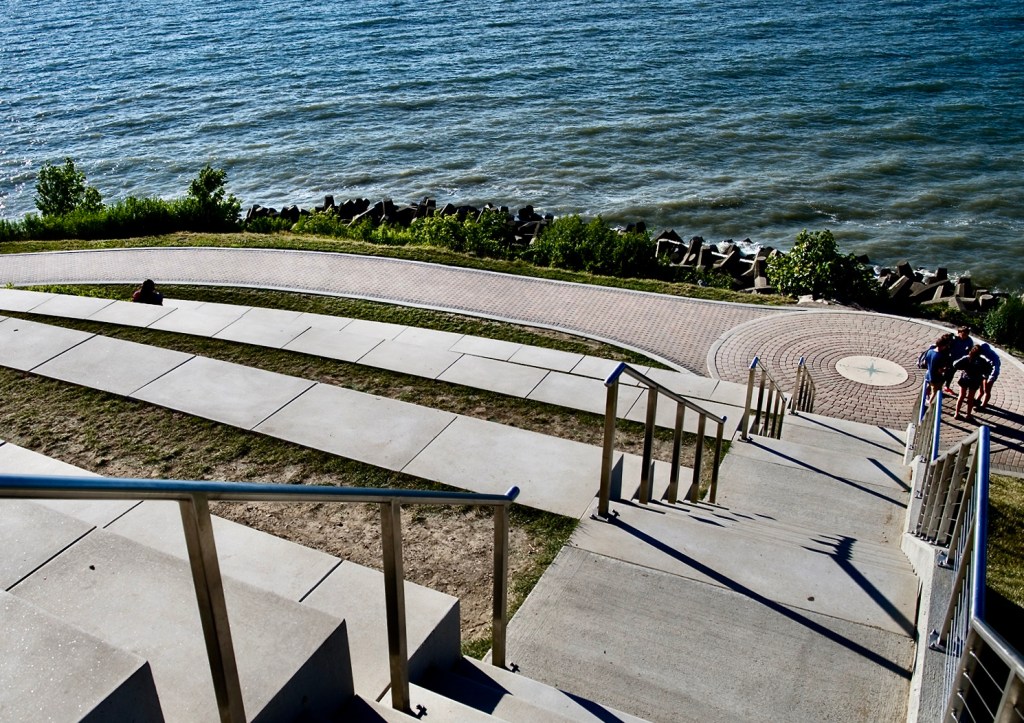
   Maggie Campbell grew up in Bay Village, ran around like a squirrel on her dead-end street and through nearby back yards, went to grade school and high school in Bay Village, got her first job at the Bay Pool, and didn’t know West Park existed until she moved away from home and got married. West Park is eight miles from Bay Village.

   At first there wasn’t anybody anywhere in West Park. The wilderness didn’t have a name. There were some Indians who came and went. At the turn of the 19th century, it was lots of land, a handful of homes, and a few wagon paths. The paths were rutted and often impassable. The land was named for John West, an early pioneer.

   John West and his wife were from Ireland. They weren’t the founders of the new community, but they had a 600-acre farm with a 25-acre front yard and an artificial lake with rowboats on it. The land around the lake was called West Park. Over the years everybody came to call the entire locality the same thing.

   The terrain is bordered to the north by Lakewood, which is on the south shore of Lake Erie. It is west of Brooklyn and east of Fairview Park. Everything else is south of it. It is twelve and a half square miles formed as Rockport Hamlet in 1892, incorporated as Rockport Village in 1902, and finally renamed the Village of West Park in 1913. In the 1920s it was its own city with its own government. It became the last independent city to be annexed by Cleveland in 1923.

   George Reitz, who was the mayor at the time, said, “I’m no longer going to be mayor of West Park. I’m going to be a resident of Cleveland.” Cleveland was the fifth largest city in the country in thew 1920s.

   After Maggie and Steve de Luca got married, they moved in with Steve’s brother Fat Freddie in Little Italy, but it got off to a bad start and went downhill. Fat Freddie had a heart of gold but a Red Skelton sense of humor that got on Maggie’s nerves. It wasn’t long before she wanted to do him in. She might have but for Fat Freddie being friends with the pastor of Holy Rosary Church and the local mobsters. Besides, he was her brother-in-law and murdering him would have looked bad at the next family picnic.

   The first road in West Park was a wooden plank toll road. Horse drawn streetcars went back and forth. All the other roads were unimproved, a mess of mud every spring and buried by snow every winter. Oswald Kamm opened a grocery store at the intersection of what is now Lorain Ave. and Rocky River Dr. Most people called West Park the “lost city.” Getting to the grocery store was an ordeal. Whenever a thunderstorm broke out everybody stabled their horses at the store and stayed the night.

   There are four West Park neighborhoods, which are Kamm’s Corners, Riverside, Bellaire-Puritas, and Jefferson. Kamm’s Corners is Irish Catholic. There are taverns right and left of the corner. Riverside was largely unsettled until Cleveland Hopkins Airport was built there in 1925, when it became airplane country. Bellaire-Puritas is manufacturing intensive, largely due to the presence of many industrial parks. It is adjacent to highways and has access to the Norfolk-Southern and CSX rail lines. Jefferson was thinly populated for a long time but following annexation residential development moved forward. Grayton Rd. is north of the airport and more-or-less follows the lay of the Rocky River. Alan Apelt grew up on Grayton Rd. when it was a dirt road and everything around it was farmland. 

   “If a car was driving down our road we knew they were lost,” Alan said. His grandfather August farmed vegetables there in the 1920s. After he passed away one of his four children took over the family farm. Rudy Apelt built a greenhouse while still farming outdoors. In the 1950s Cleveland was known as the “Greenhouse Capital of the Americas.” Through the 1960s there were more than fifty of them around town growing cucumbers, tomatoes, and leaf lettuce. It was where the Central and West Side Markets got their produce.

   After Rudy met his maker Alan and his brother Ron took the helm. They specialized in English seedless cucumbers. When his brother passed away Alan turned the greenhouses into a hydroponic operation. He gave it up in 2016 and dismantled them. In their place he planted 400 Chinese Chestnut trees.

   “Chestnut trees are the easiest things to manage on a day-to-day basis by yourself,” he said.

Three years later he had a harvest to meet the rising trend in cooking of using chestnuts. They have a sweet flavor and potato-like consistency. When they fall from their branches, they are enclosed in spiney burrs. Picking them up means wearing gloves. Picking them up barehanded means getting stabbed by a spiny burr.

   John West’s red brick house still stood on W. 138th Street when Maggie and her husband bought a house on West Ave. in the Jefferson neighborhood. John Marshall School of Engineering was at one end of the street and Cleveland Police First District headquarters was at the other end. Steve’s father had been a lawyer for the Cleveland Mob. Steve was ambivalent about law and order being close to hand.

   There weren’t any farms left. All the greenhouses were gone. Three interstates were nearby. There were three rail transit stops within hiking biking distance. Almost everybody was Irish, Latino, or Black. Maggie was Scottish, which was close enough. Steve was Italian, which wasn’t close, at all. But he had been born and bred in Little Italy, where the Dago’s were surrounded by Wasps and Jews. He knew how to mix it up with folks who were nothing like him.

   If things got sketchy, being from Little Italy, he knew how to take care of himself. If they got dangerous, he knew who to call. If Fat Freddie proved to be not enough back-up, he knew his brother knew enough dangerous men to set things right. In the event, their home was their castle. Just in case, they always had two or three dogs in the house. They weren’t Chihuahuas or Miniature Poodles, either.

   “A good dog makes good neighbors,” Maggie always said.

Ed Staskus posts monthly on 147 Stanley Street  http://www.147stanleystreet.com, Made in Cleveland http://www.clevelandohiodaybook.com, Down East http://www.redroadpei.com, and Lithuanian Journal http://www.lithuanianjournal.com. To get the site’s monthly feature in your in-box click on “Follow.”

“Bomb City” by Ed Staskus

“A police procedural when the Rust Belt was a mean street.” Sam Winchell, Beyond Books

Available on Amazon: https://www.amazon.com/dp/B0F1LM1WF9/ref=sr_1_1?crid=2MYAQAOZIC2U9&dib=eyJ2IjoiMSJ9.hTm7BGbiQbSe5ZapFwYPPfcwOpTe-Vdg6VLE4aGyTyk.Z0R-VNBWWEcvKcNaO9LdCOUnNIOOXgvYkRS_FXiXuHk&dib_tag=se&keywords=bomb+city+ed+status&qid=1742136726&sprefix=bomb+city+ed+staskus%2Caps%2C84&sr=8-1

Cleveland, Ohio 1975. The John Scalish Crime Family and Danny Greene’s Irish Mob are at war. Car bombs are the weapon of choice. Two police detectives are assigned to find the bomb makers. Revenge is always personal. It gets personal.

A Crying of Lot 49 Publication
Bomb City USA

By Ed Staskus

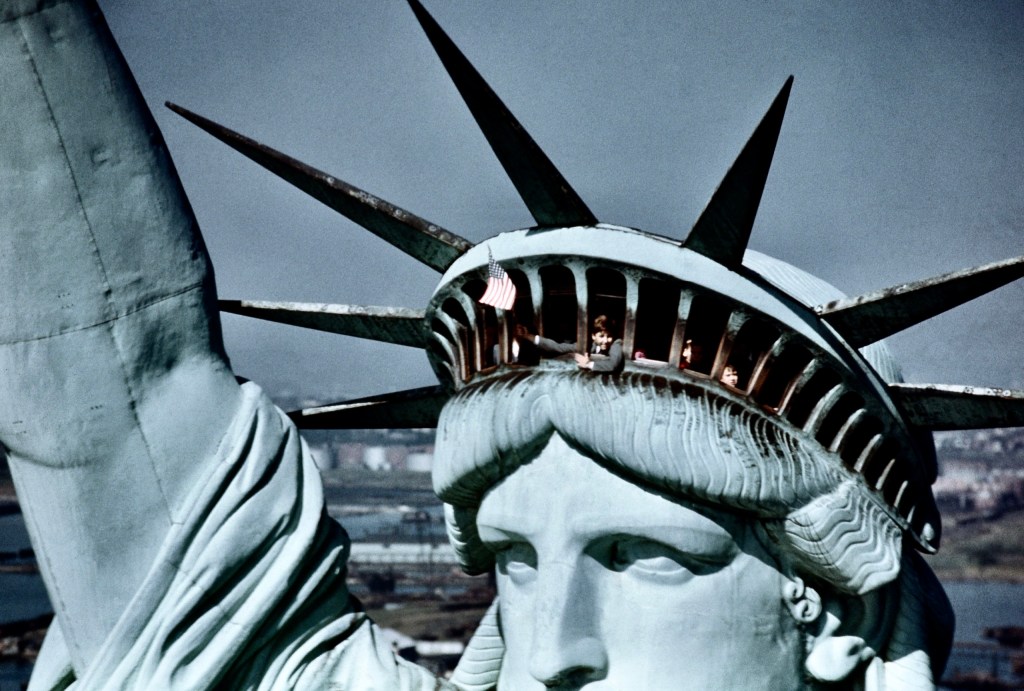
   When I went to work as the night clerk at the Versailles Motor Inn on E. 29th St. and Euclid Ave. in the mid-70s, Cleveland, Ohio was the bomb capital of the country. There were 21 bombings in the city in 1976 and 16 more in the surrounding county, carnage every ten days, making it tops in the United States, according to the Bureau of Alcohol, Tobacco, and Firearms. The federal lawmen christened Cleveland “Bomb City USA.”

   “A bombing sends a real message and it commands a lot of attention,” said Rick Porello, a northeast Ohio career police officer. “Danny Greene was said to have paid Art Sneperger, his main explosives guy, extra if the bombing generated news coverage. Art got paid a bonus if the thing got on television or in the newspapers.” If it bleeds it leads was and still is the leitmotif of newsmen everywhere.

   Art Sneperger made his own headlines in 1971 when, working at the behest of Danny Greene, he suddenly found himself engulfed by hellfire while planting explosives under the car of the Irishman’s old friend and new enemy Mike Frato. Fumble fingers don’t pay, although the fact of the matter was that Danny Greene set the bomb off from across the street. He had come to believe Art had ratted him out to the FBI.

   Six years later Danny Greene was himself blown up walking out of a dentist’s office in Lyndhurst. The gangster had paid cash, so the dentist ignored the sonic boom. Money was no good where the Irishman was going. Nobody outside his Celtic Club shed a tear.

   The bomb was in a Chevy Nova parked next to Danny Greene’s Lincoln Continental. It was a Trojan Horse. When it went off, set off by remote control, the Nova, the Continental, and the Irishman were reduced to scrap metal. The gangster usually wore all green clothes, wrote in green ink, and drove a green car. He wasn’t going incognito. It was easy to see it was him getting into the Lincoln. The bomb blew one of his arms one hundred feet across the parking lot. The lucky Celtic Cross he wore around his neck pierced and stuck into the asphalt. The coroner didn’t bother trying to put him back together.

   The used Chevy Nova came from Fairchild Chevrolet in Lakewood. “We heard the owner of the car lot might have been involved,” said Bob Gheen, a teenager at the time. The car had once been his father’s car. “They never transferred the title out of my dad’s name. Rick Porello from the Lyndhurst Police Department showed up at our door on Saturday morning and drove us to identify what was left of the car. We had to answer several questions and that’s pretty much the last we heard of it.”

   I was taking classes at Cleveland State University at the time but because I didn’t have a scholarship or any grants, and nobody would give me a loan to read old literature, I had to pay tuition fees and book costs myself. I was living in Asia Town, in a Polish double on East 34th St, upstairs in a two-bedroom with a roommate, but even though I knew how to live on next to nothing, I needed something to pay the bills and some more to pay for school. I was sick of Manpower and their stingy paychecks. I went looking for a steady job.

   The Versailles Motor Inn was built in the mid-60s, meant to piggyback on the Sahara Motor Inn a few blocks away at E. 32nd St., which was built a few years earlier. The Sahara wasn’t hiring, but the Versailles was, and I thought if it is anything like the Sahara, I was the young man for the job. I later found out I was the only young man to apply for the job.

   All the rooms at the four-story Sahara Motor Inn featured a television, air conditioning, piped-in music, and a dial phone, the first ones in rooms in northeast Ohio. There were three presidential suites and three bridal suites. There was a heated swimming pool, a dance floor, and a patio on the second floor. There was a continental dining room with velvet armchairs and a starlight ceiling. There were four cocktail lounges. The waitresses wore Egyptian outfits and the waiters wore fezzes. There were eight-foot paintings of Cleopatra, King Tut, and Queen Nefertiti in the lobby.

   Other than that the Versailles Motor Inn had 150 rooms, exactly the same as the Sahara Motor Inn, that is where the resemblance ended. My place of employment had a bar, a coffee shop, and a lobby. It featured sunken pit seating in the lobby where nobody ever went. The lighting was bad. The front doors facing Euclid Ave. were kept locked under penalty of death. Unlike the Sahara Motor Inn where the plants in the lobby were real geraniums, rhododendrons, and palm trees, everything at the Versailles Motor Inn was fake. The front desk was cheap veneer and the carpet was cheap, too, going threadbare. There was a drive-up side entrance at one end of the front desk and the door to the bar was at the other end of the desk. There were two elevators that made a racket going up and down.

   The Sahara Motor Inn attracted weddings, conventions, and business meetings. TV crews filming episodes for “Route 66” stayed there sometimes. The Versailles Motor Inn attracted business like peddlers on a tight budget, the sketchy who said hold all their calls, and the John and Jane trade. One weekend a flock of Baptist ministers booked all the rooms on three floors.

   I was glad to get the job since I could walk there from where I lived in Asia Town, it paid reasonably well, and I would have about half of my hours from 11 PM to 7 AM to do homework. I reconciled the day’s receipts before and after my shift. We had a floor safe bolted down in the back office. My responsibilities were mainly checking in guests and taking reservations. I gave directions to late-night callers, answered inquiries about our hotel services, which was easy enough since there were hardly any, and made recommendations to guests about nighttime dining and entertainment options, which was also easy.

   “In the 1970s downtown was dead,” said John Gorman, disc jockey and program director at radio station WMMS. “The Warehouse District and Playhouse Square weren’t happening yet. There was no reason to come.” The nickname of the progressive radio station was ‘The Buzzard.’ Downtown Cleveland’s nickname was ‘The Wasteland.’

   One night, while nothing much was happening on my side of downtown, and I was in the back office boning up for an exam the next week, Shondor Birns, Public Enemy No. 1 in Cleveland for a long time, strolled out of Christy’s Lounge, a strip club on Detroit Ave. on the near west side. It was across the street from St. Malachi Catholic Church. It was Holy Saturday, easing into Easter Sunday. As it happened, there wasn’t going to be any resurrection for the gangster after what was going to happen happened.

   During Prohibition the Birns family had turned to bootlegging, working a still in their basement for Cleveland Mafia boss Joe Lonardo. Mother Birns went up in smoke when the still exploded. After Shondor dropped out of high school, he was subsequently arrested 18 times in 12 years. After his 6th or 7th arrest a Cleveland prosecutor declared, “It is time the court put away this man whose reputation is one of rampant criminality.”

   He hooked up with the Maxie Diamond gang and got into the protection rackets. He muscled into the numbers and policy games. He opened restaurants like the Ten-Eleven and Alhambra. His big mistake was hiring Danny Greene as an enforcer. The relationship soured and Shondor Birns put a contract out on Greene. When the Irishman discovered a bomb attached to his car, he disarmed it himself and showed it to Cleveland Police Lieutenant Ed Kovacic, who offered him police protection. “No, for whatever it’s worth,” Danny Greene said, leaving the Central Station and taking the bomb with him. “I’m going to send this back to the old bastard that sent it to me.”

   When the old bastard left the girlie show, got comfortable behind the wheel of his Lincoln Mark IV, and turned the key in the ignition, a package of C-4 exploded underneath him. His head was blown through the roof of the car. The cigarette he had been meaning to light was still between his lips. His torso landed somewhere outside the passenger door. His legs landed somewhere farther away. 

   Mary Nags owned a print shop on Detroit Rd. It shared a common parking lot with the strip club. She got a call from the police telling her not to come to work on Monday. “They said a man had been blown up and parts of him were scattered around in our back lot.” The forensics men spent a day finding all the bits and pieces of the once infamous Shondor Birns.

   Police detectives focused on the numbers men in the ghetto with whom the gangster had been feuding. That turned out to be a dead end. “It’s dumb to talk about blacks doing Shondor,”one of the numbers men said.  “He wasn’t no bad fella. He was white but it didn’t make no difference. Shon had a black soul. He was black through and through.”

   Everybody knew Danny Greene had ordered it done, but charges were never brought after the actual bomber died. The Irishman had contracted Hells Angel Enis “Eagle” Crnic to do the job. The biker was later blown to bits while placing explosives to the underside of a car belonging to Johnny “Dell” Delzoppo. If the district attorney wanted to pursue the case, he would have to deliver his subpoena to the bottomless pit, where the Eagle was living next door to Art Sneperger.

   The first time I was robbed at the Versailles Motor Inn I wasn’t robbed, because I was surprised and reacted without thinking. A young black man filled out a registration card, handed me a twenty, and when I turned around to get him his key, started rifling the cash drawer. “Hey!” I shouted, lunging forward and smashing the drawer shut on his hand. He ran out yelping and cursing.

   The second time I was robbed I was robbed. The young black man didn’t bother registering. The bandit was wearing a jacket and suggested he had a gun in his jacket pocket by pointing the pocket at me. “Know what I mean?” he said. I had seen plenty of cops and robbers movies. I knew what he meant.

   “It’s not my money,” I said opening the drawer, stepping back, and raising my hands to the ceiling. What’s a simple man to do staring at the wrong end of a gun? He said I could put my hands down. “This ain’t no western movie matinee, but don’t mess around.” He took all of the night’s earnings except the loose change. I called the police, a patrol car pulled up, I made out a report, and they left. The men in blue seemed more indifferent than not.

   “Don’t let it happen again,” my boss said in the morning. He wasn’t indifferent about the missing money.

   “What do you suggest?”

   “Do you want to keep your job?”

   “I guess so,” I said, hedging my bets.

   “All right then,” he said, and that was the end of his words to the wise.

   My last night at the Versailles Motor Inn was the same as most nights, until it wasn’t. I was busy until 2:30, then it was slow as a shuttered orphanage. I sat in the back office reading until I got drowsy. I took a walk through the gloomy lobby to wake myself up and was standing behind the front desk doing nothing when in the next second there was a bright flash and a roaring bang. The doors of the bar flew off their hinges and every single bit of glass the length of the hallway was blown to smithereens.

   Other than the echo from the blast I couldn’t hear anything, slowly backing away from the desk and backing out the side door, sidling along the outside wall until I came to the front of the building. I stood outside until I was breathing again and my hearing started to come back. I decided I wasn’t hurt since nothing hurt. Back inside the dust was settling and it didn’t look like too much was on fire. The phone was still working. I called the police and they arrived in the matter of a minute, the fire department hard on their heels.

  The firemen hauled hoses inside and sprayed water on everything from one end of the bar to the other. The hardwood bar was split in half and the stools mangled. All the tables and chairs were helter-skelter. Many of them were splintered. All of the bottles and glasses and mirrors were shattered. It was a soggy mess when the firemen got done with it.

   There were forty or fifty guests tucked into their beds when the bomb went off. Some of them on the lower floors were woken up by the blast. A policeman stood by the elevator and whenever somebody came down asking what the noise had been told them to go back to bed.

   I went over what happened with a police detective. He asked me a hundred questions but finally told me to go home. It was five in the morning. I walked up E. 30th St. to Payne Ave, past Dave’s Grocery and Stan’s Deli, to my rented rooms on E. 34th St. I didn’t see another soul, although I saw thin ice in the shadows on every street. My roommate was dead asleep. Mr. Moto my Siamese cat followed me to my bed and jumped on top of me when I fell into it. He curled up while I lay awake.

   I quit my job by phone the next day. The only time I went back was to collect my last paycheck. My ex-boss looked at me sideways like I had something to do with the bombing. When I asked, he said the police had found a door forced at the back of the bar and believed that was how the intruder got in, taping two sticks of dynamite to the underside of the bar. He said I was lucky the wood was oak.

   “One stick can blow a 12-inch-thick tree right out of the ground, do you know?” he said.

   “I don’t know and I don’t care,” I said. There were sheets of plywood hammered up everywhere. A month later I heard talk that the bar’s proprietor, who leased the space from the Versailles Motor Inn, had fallen behind paying his protection money and the bombing was a way of settling accounts.

   The Mob was big in Cleveland in the 1970s. When John Scalish died after 30-odd years as the underworld’s power broker, Jack “King of the Hill” Licavoli took over. He lived in an unassuming house in Little Italy, up the hill towards Cleveland Heights. “Jack was the last of the old-school Cleveland mobsters,” said James Willis, his downtown lawyer. “Cleveland had the best burglars, thieves, and safe crackers in the country. I know, I represented a lot of them.”

   Jack White, another of his names, a play on his dark Sicilian complexion, got his start bootlegging in St. Louis. He came to Cleveland in 1938 and worked his way up. “A lot of the guys coming up were just out for themselves, but not Jack. He looked out for the operation and he was so good at his job that I thought it would never end,” James Willis said. “He was very secretive and not at all flamboyant. We would only ever talk in person.”

   “No one thought it would be Licavoli taking over,” Rick Porello said. “He was an old miser. One time he was caught by a store’s security for switching the price tag on a pair of trousers. When they found out who he was they dropped the charges.”

   I soon found work in the Communications Department at Cleveland State University, on the 16th floor of Rhodes Tower, working for their new film studies professor. I was an English major, but movies were close enough. They were becoming the new literature, anyway. My job was picking up whatever art house film my boss was screening from the mail room, roll the 16 mm projector out of storage, screen the movie to his class, and send it on to the next school that wanted it. In return I got free tuition and a closet that passed for an office.

   I watched many French New Wave movies, Japanese samurai movies, and 1940s Warner Brothers crime movies during my work-study year, films that the Cleveland State University library had tucked away in secret places. I projected them on my office wall at the end of the day. I didn’t have a TV at home, but the movies I watched were better than anything on TV, anyway.

   Two years after I left the Versailles Motor Inn, John Nardi, who was secretary-treasurer of Vending Machine Service Employees Local 410 and high up in the Mob’s chain of command, sauntered out of his office a couple of blocks away from where I had worked as a night clerk, stepped into his Oldsmobile 98, and turned the key. The small car parked next to him exploded. It was another Trojan Horse attack. The bomb, to make sure, was packed with nuts and bolts. John Nardi was blown to kingdom come. Bomb City USA was alive and well.

Ed Staskus posts monthly on 147 Stanley Street http://www.147stanleystreet.com, Made in Cleveland http://www.clevelandohiodaybook.com, Down East http://www.redroadpei.com, and Lithuanian Journal http://www.lithuanianjournal.com

“Cross Walk” by Ed Staskus

“A Cold War thriller that captures the vibe of mid-century NYC.” Sam Winchell, Beyond Books

Available on Amazonhttps://www.amazon.com/dp/B0CRPSFPKP

The end of summer, New York City, 1956. Times Square, Coney Island, and the Mob on the make. President Eisenhower on his way to Brooklyn for the opening game of the World Series. A killer waits in the wings. A Hell’s Kitchen private eye scares up the shadows.

A Crying of Lot 49 Publication

Thirty One Words

By Ed Staskus

   After my parents emigrated from Sudbury, Ontario to Cleveland, Ohio in the late 1950s I first attended a public school for a year and after that a parochial school through 8th grade. Iowa Maple Elementary School’s first grade was full of strangers. St. George’s Catholic School was full of the progeny of Eastern Europeans, children like me. After I graduated I went to St. Joseph’s, a Catholic all boys high school. One thing we did, no matter the school, was recite the Pledge of Allegiance first thing in the morning, facing an American flag with our right hands on our hearts.

   “I pledge Allegiance to the flag of the United States of America and to the Republic for which it stands, one nation under God, indivisible, with Liberty and Justice for all.” When we were done we sat down and cracked open our books.

   At first, I wasn’t sure I was duty bound to recite the pledge, There wasn’t any such thing in Canada, although we did sing “God Save the Queen.” Who doesn’t like breaking into song first thing in the morning? I mentioned my doubts to my second grade teacher. Our nuns belonged to the Sisters of St. Francis of the Providence of God. She sent me to the principal. The principal set me straight. “You’re not in Canada anymore, young man,” she said. “As long as you’re here in the United States you’ll recite the pledge like everybody else.”

   The pledge was officially recognized by the United States in 1942. Congress wanted all schoolchildren to recite it every day. The next year, 1943, the Supreme Court ruled that requiring a person to say the pledge is a violation of the First Amendment to the Constitution. The court said students cannot be compelled to recite the pledge or salute the flag. The principal was in violation of the Constitution, although I didn’t bring it up to her. One reason was  that I didn’t know there was such a ruling. The other reason was that the principal was a power unto herself. There was no sense in poking the bear with a stick.

    The nuns of the Sisters of St. Francis of the Providence of God were stern. They knew how to put the fear of God in us. They often reminded their charges we were sinners in the hands of an angry God. It was a parochial school, which meant it was a private school. They made the rules. It was their way or the highway. 

   Supreme Court or no Supreme Court, during the 1950s and 1960s states continued to require recitation of the pledge. To this day forty seven states still mandate the pledge be recited in public schools, with varying exemptions. The fine print allows students to opt out. In my day hardly anybody except atheists read the fine print. Everybody recited the pledge. Nobody wanted to be known as an atheist or a communist.

   In 1954 President Dwight Eisenhower added the words “under God” to the pledge. They hadn’t been in the original. The change was made at the urging of the Knights of Columbus, a Catholic men’s fraternal organization, and approved by a Joint Resolution of Congress. “From this day forward,” the president said, “the millions of our school children will daily proclaim in every city and town, every village and rural school house, the dedication of our nation and our people to the Almighty. To anyone who truly loves America, nothing could be more inspiring than to contemplate this rededication of our youth, on each school morning, to our country’s true meaning.”

   Two years later President Dwight Eisenhower made the phrase “in God We Trust” the official motto of the United States. The phrase began appearing on currency in the early 1960s. The New York Times wasn’t impressed, saying “Let us carry our religion, such as it is, in our hearts and not in our pockets.” Others said the phrase should have been “In Gold We Trust.”

   The Pledge of Allegiance was easy enough to memorize. Even with the addition of “under God” there are only thirty one words. By the time I graduated high school I had recited it more than two thousand times. After the first hundred-or-so recitations the speaking of it became routine. It was just something we had to do first thing in the morning. When I went to Cleveland State University I found out reciting the Pledge of Allegiance was not practiced there, not that it mattered. By then I had stopped believing in “My country right or wrong.”

   I hadn’t thought about the pledge for decades when it unexpectedly cropped up one Christmas Eve over a Scrabble board. My wife and I were at my mother’s house for dinner. My parents grew up in Lithuania and celebrated Christmas on Christmas Eve. The ethnic holiday is called Kucios. The meal is traditionally meatless. It consists of twelve dishes representing both the twelve months of the year and the Twelve Apostles. An empty place at the table is often set for deceased family members to signify their presence and remembrance. My father had died some years earlier. We kept the chair he had always sat in empty during dinner.

   After dinner, and after opening our presents, my sister, Rita, my niece’s boyfriend, Dean, and I sat down in the living room to play Scrabble. My wife was not allowed to play because she was always breaking the rules by laying down foreign words – she spoke some French and German – and making up words. She felt it was her right, no matter what the rules said. She left the living room and by way of unintended consequences got buttonholed by my niece, Silvija, who was spinning her latest conspiracy theories in the kitchen. Once she got started she wasn’t going to be coming up for air any time soon.

    Silvija and Dean had hooked up at Miami University. After graduating they moved to Colorado together and set up housekeeping. We hadn’t seen them for several years. There was an ill at ease vibe in the air between them, but nobody asked what it was about. Silvija could be a time bomb.

   I was good at Scrabble. My sister was better. Dean had only played it a few times, but he was good with words. Halfway into the game I laid out the word ‘pledge.’ One of my tiles bridged a triple word score square on the game board. The move shot me into first place. 

   “Darn,” Dean said. “I had a word for that spot.”

   “Sorry about that,” I said, even though I wasn’t sorry at all. Even though it is true that we learn more from losing than winning, everything is bright and shiny on the Scrabble board when you are winning. Winning is all you need to know in our day and age.

   “Do you know the Pledge of Allegiance was written by a socialist,” Dean said out of the blue.

   “That’s hard to believe,” I said. “Americans hate socialists.” 

   Many Americans don’t see the social doctrine as the way to achieve social equality. They conflate it with communism. They think it means the government would take control of the means of production, throw tycoons in jail, and everybody would end up poor.

   “Look it up,” Dean said. “All those kids who have been reciting the pledge all these years have been mouthing a socialist’s words.”

   When I looked it up I discovered the Pledge of Allegiance was written 1892 by Francis Bellamy, a Baptist minister and Christian Socialist. The ideological movement flourished from the mid-19th century into the early 20th century. It endorsed socialist economics based on the Bible and the teachings of Jesus Christ. Acts 4:32 comments on early believers sharing their assets and possessing everything in common. Matthew 6:24 and Luke 3:11 both advise against serving wealth and encourage sharing resources. Christian Socialists believed capitalism was idolatrous and rooted in greed. Unlike what prevails today among many conservative Christians, who believe avarice is good, they believed it was a sin. They saw social inequality as being caused by greed and capitalism.

   An earlier pledge had been written in 1885 by Captain George Balch, a Union officer in the Civil War, who later wrote a book about teaching love for your country to children in public schools. Francis Bellamy adapted it, rewriting it, tightening it up, and making it more rhetorical. The reason he updated the pledge was because he had gotten a job in the premium department of the magazine Youth’s Companion. He had been forced from his Boston pulpit for his Bible-thumping sermons about the evils of capitalism and needed gainful employment.

   The Youth’s Companion was trying to sell more American flags to schools than they had already sold. The magazine had half a million subscribers. They wanted more subscribers. They had already sold 26,000 flags since 1888 as a premium to solicit subscriptions but sales were flagging. They needed a new marketing approach. They began offering a free picture of George Washington with every flag. They became enthusiastic supporters of the schoolhouse flag movement, which aimed to see a flag flying above every schoolhouse in the country. 

   “The flag over the schoolyard makes the nation a real thing to the very ones who are most in want of that lesson,” Francis Bellamy said. “The daily ceremony of raising it and saluting it is a perpetual education.” Honor and venerate the flag was the order of the day.

   In addition to the sales angle, there was an Americanization angle. The late 19th century was a boom time for immigration into the United States, fueled by famine, political unrest, and religious persecution. Many came for economic opportunity. Francis Bellamy was a true believer in the socialist movement and the nationalization movement. He believed that immigrants fed the country’s economic engine but that they could be harmful to the American way of life. He believed they needed to assimilate as quickly as possible. The pledge would act as  daily reminder. It would foster solidarity and patriotism.

   The pledge was published in Youth’s Companion in September 1892, dovetailing with flag salute ceremonies scheduled for Columbus Day the next month. The salute became known as the Bellamy Salute, stretching the arm out forward, palm downward, in line with the forehead, towards the American flag. It was practiced that way until World War Two, when the Nazi-like salute was replaced with a hand over the heart. 

   In spite of his belief that “Jesus was a socialist” and his jeremiads against capitalism, Francis Bellamy spent most of his working life in advertising, which is a cornerstone of capitalism. He spent nineteen years working in the profession in New York City and ten more years doing the same in Tampa, Florida, where he died in 1931.

   My brother and his family, who were a fidgety, impatient family, had gathered up their presents and left early. My wife was still stuck in the kitchen with Silvija. It had started to snow on the other side of the windows. Rita, Dean, and I were on the last lap of our Scrabble game. Dean was out of the running. Rita and I were neck and neck. I had six tiles left. They included the letters ‘c’ and ‘h’ and ‘y,’ all three of them higher point tiles. If I could run my rack I would win the game.

   It took a few minutes, my sister needling me to hurry up, hoping I wouldn’t run the rack, but I found the spot on the board I was looking for and put down the word ‘anarchy.’ I scored forty-some points, and since I had laid out all my tiles. I got to add on all the points on the tiles Dean and Rita were left holding. I won the game going away.

   “You pulled away with the pledge word and now you finished us off with the anarchy word,” Dean said. “It’s like some kind of yin and yang.”

   “You know what they say about those two peas in a pod,” I said.

   “No, what do they say?” Dean asked.

   “The way I’ve heard it, next to swearing an oath to anarchy, the next worst mistake in this world is pledging allegiance to a state, especially the state we’re in nowadays.”

Ed Staskus posts monthly on 147 Stanley Street http://www.147stanleystreet.com, Made in Cleveland http://www.clevelandohiodaybook.com, Atlantic Canada http://www.redroadpei.com, and Lithuanian Journal http://www.lithuanianjournal.com. To get the site’s monthly feature in your in-box click on “Follow.”

“Bomb City” by Ed Staskus

“A police procedural when the Rust Belt was a mean street.” Sam Winchell, Beyond Books

Available on Amazon: https://www.amazon.com/dp/B0F1LM1WF9/ref=sr_1_1?crid=2MYAQAOZIC2U9&dib=eyJ2IjoiMSJ9.hTm7BGbiQbSe5ZapFwYPPfcwOpTe-Vdg6VLE4aGyTyk.Z0R-VNBWWEcvKcNaO9LdCOUnNIOOXgvYkRS_FXiXuHk&dib_tag=se&keywords=bomb+city+ed+status&qid=1742136726&sprefix=bomb+city+ed+staskus%2Caps%2C84&sr=8-1

Cleveland, Ohio 1975. The John Scalish Crime Family and Danny Greene’s Irish Mob are at war. Car bombs are the weapon of choice. Two police detectives are assigned to find the bomb makers. Revenge is always personal. It gets personal.

A Crying of Lot 49 Publication
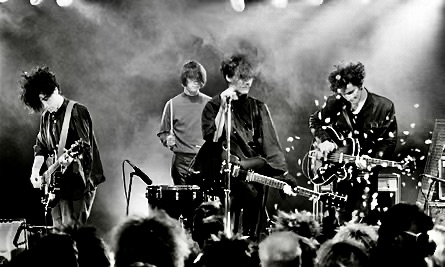
Not Dead Enough

By Ed Staskus

   Vera Nyberg was in the middle of a zigzagging dream when her cell phone rang. She kept it on the nightstand when sleeping. She let it ring, gathering her senses. Laying on her back she finally pawed for it and held it up over her head so she wouldn’t have to move her head. She saw it was 5:45 in the morning. It was the department. She took the call.

   “It’s my day off,” she said. “This better be good.”

   “Look out your front window,” the man on the other end of the line said. It was Dave Campbell. He was the boss of the Criminal Investigations Unit. He was her boss.

   Her back bedroom window faced onto Crest Ln., which was more-or-less an alley. Her front bedroom, which was empty since she hadn’t done anything to it since moving in except paint it, faced onto Riverside Dr. The street overlooked the Rocky River valley.

   Vera got up and trudged to the front bedroom. One of her cats had been sleeping with her. The other one was sleeping in the front bedroom on one of the windowsills. She went to the open window and looked down. The cat yawned, stretched, and jumped away. What she saw was the street blocked in both directions by Ford Explorer Police Interceptors. Red and blue lights were flashing. There were an ambulance, a rescue truck, and a utility truck, as well. The utility truck had probably come from Station No. 1 on Madison Ave, but the other two vehicles, she thought, must have come from Station No. 2, which was around the corner on Detroit Rd. She had slept through whatever was going on.

   There are more than 12,000 houses and buildings in Lakewood’s five-square mile footprint on the south shore of Lake Erie. The Fire Department has three stations. The lay of the land means their response times are very good. Vera hadn’t heard any sirens. She had gone out with a friend to the Alley Cat Oyster Bar in the Flats and been the worse for wear when she finally fell into bed. She swam downstream all the night.

   She couldn’t tell what the excitement was about. There were no civilian cars in the street. It couldn’t have been an accident. If it had been an accident she wasn’t likely to be involved, anyway. There wasn’t anybody sprawled out and oozing blood on the asphalt. Two police officers were leaning  over the safety railing on top of the Jersey barrier that bordered the valley side of the street from where Riverway Ave. dead ended to the corner of West Clifton Blvd. Maybe somebody had fallen into the valley. It was a long way down the cliffside, more than a hundred and fifty feet down.

   “Did somebody fall into the valley?”

   “Go take a look at what we’ve got and get back to me.”

   “All right,” she said, perplexed, She pulled on sweatpants and a light sweater. It was unseasonably cool for the first week of July. She slipped her identification card into her pocket, just in case. She stepped out her front door.

   When she walked into the street sunrise was in full swing. A police officer taking field notes looked her up and down.

   “Rough night Vera?” he asked.

   “It was a very good night,” she said. “It’s a rough morning.”

   “What there is to see is right over there,” the police officer said, leading her to the safety railing.

   She saw a rope tied to the safety railing. When she looked over the railing she saw a man hanging by the neck at the other end of the rope. He was wearing tan cargo shorts and a Cowboy Carter t-shirt. He wasn’t wearing shoes. There wasn’t much else to see. There wasn’t a sign of life to him.

   “The medical examiner should be here in about half an hour,” the police officer said.

   “Who called this in?”

   “Your neighbor one house over.”

   Tim Doyle lived in a cottage-style house with his wife. They shared their house with two shaggy dogs. He was a professional photographer. He wore his graying hair long and tied back in a ponytail. His wife Colleen was a fine gardener and his business manager. Tim was an early riser.

   “I went across the street to get some shots of the fog on the river,” he said. “I like the half-light early in the morning. I didn’t notice the hanging man at first. I was standing there at the barrier when a turkey buzzard flew over me.” The birds nested in the cliffside. “They’re ugly birds but beautiful in flight. I got a good shot of him. He dove and was coming back up when I saw the man hanging there. I couldn’t see his face too well, but I think I recognize the t-shirt.”

   “We’re going to get him up and wait for the medical examiner,” Vera said. “Are you willing to take a look at him then?”

   “I’ll be on my front porch. I need a cup of coffee.”

   The hanged man was less than three feet down from the edge, although the rope looked longer. Vera saw it wasn’t taut and wondered why. Two firemen began pulling him up by his armpits but stopped. “He’s stuck on something,” one of them said. Vera saw the back of the man’s belt was caught on a small stump jutting out from the cliffside. One of the firemen carefully stretched down and freed the belt from the stump  They pulled him up and laid him down in the street. Vera borrowed a pair of nitrile gloves and began looking the man over. The heels of his bare feet were scuffed and bloody. He was fit but thick around the middle. There was still some color in his face. She thought whatever happened must have happened just before sunrise. There wasn’t anything in his pockets. 

   The Cuyahoga County Medical Examiner arrived in twenty minutes. He  was in his late 30s, like her, but lanky and tall. He was six and a half feet tall. Vera was five and a half feet tall. She was always looking up at the underside of his bony chin. His name was Isaac but every time she saw him she thought of Ichabod Crane. She called him Ichabod, but only out of the man’s earshot.

   He began by crouching over the hanged man and examining his neck. After a minute he frowned. He looked up at Vera.

   “He didn’t die by hanging,” he said. “Ligature marks from hanging typically appear as a groove or furrow encircling the neck, obliquely positioned above the thyroid cartilage and discontinuous at the point of suspension. There are almost no ligature marks and there is no groove.”

   Vera got the gist, ignoring the jargon.

   “So what did he die of?”

   “I’ll show you what I think killed him.”

   He reached into his evidence bag and pulled out a pair of tweezers. He pushed the tweezers up one of the man’s nostrils and extracted a crumb of green fabric.

   “I think he was smothered, probably by a green shaggy pillow,” he said, probing the other nostril. He was still probing it when the man sneezed. Vera jumped back like she had stepped on a snake and the medical examiner almost fell over.

   “What’s going on?” the man groaned.

   “He’s not dead,” Vera said.

   “Apparently not,” the medical examiner said, recovering his poise and checking the man’s vital signs. He checked his pulse. He checked his respiratory rate. He checked his doll’s eye reflex, moving his head gently back and forth and observing his eye movements.

   “He’s definitely alive and seems to be all right, but let’s get him to Fairview as soon as possible,” he said. The Cleveland Clinic Hospital in Fairview Park was five minutes away.

   “Wait,” Vera said.

   She waved across the street at Tim Doyle, who put his coffee cup down and joined them. He looked at the man.   

   “That’s Bill,” he said. “He lives in that house there.” He pointed to a large house next to another large house on the opposite corner. Both houses faced the valley. “He lives with a partner. His name is Walter, although I call him Wally. He doesn’t like it, but that’s what I call him. He and Bill haven’t been getting along lately.”

   “How do you know that?”

   “I’ve heard the fights in their backyard the past two months. All the neighbors have. Wally’s been in a foul mood lately.”

   “Keep him right here,” Vera said to the medical examiner, pointing at Bill. “When you see me coming back put something over his face.”

   “He needs to go to Fairview the sooner the better.”

   “I’ll be back in five minutes.”

   Vera crossed Franklin Ave., walked to the second house down, and went up the front steps. The house had an old-fashioned slate roof. It had recently been spruced up with shiplap siding. An oak tree kept the house shaded. There were two large, glazed pots of scarlet geraniums flanking the front door. One of them was knocked over. Loose flower petals on the ground looked like spots of dried blood. The blinds in every window were drawn. She rang the doorbell. A man dressed like Jimmy Buffett answered the door. There were two suitcases and a carry-on next to him. What she could see of the indoors looked dim and gloomy. 

   “Let’s go,” he said. “I’ll be glad to get out of here.”

   “Where to?” Vera asked.

   “The airport.”

   “I’m not your Uber,” Vera said, showing him her identification card.  “Are you Wally?”

   “I’m Walter,” the man said.

   “Before you leave for the airport, I wonder if you would come with me for a minute.”  It wasn’t a request. A police officer had come with her. He was standing behind her.

   “I’m already running late for my flight.”

   “This will only take a minute.”

   They went down the steps when Vera suddenly said, “I forgot something, be right back.” She made a sign the police officer understood and beelined up the steps and into the living room. In the living room she saw two green shaggy pillows on a sofa. Back outside they walked to where Bill was. The medical examiner had covered him with an evidence sheet. He quickly peeked under the sheet and put a forefinger to his lips, signaling Bill to be quiet.

   When they got to the evidence sheet Vera said to Walter, “We discovered a man hanging from the safety rail this morning and we’ve been made aware he lived in the house you also occupy. Would you mind taking a look at the man and see if you can identify him.”

   “Is he dead?” Walter asked.

   Vera didn’t answer. The medical examiner uncovered the face of the man. Walter looked at him and said, “My God, it’s Bill, what happened to him?”

   Bill opened his eyes and said, “You’re what happened to me.”

   Walter was dumbstruck. His face went white. His eyes got big as a tree frog’s. “You can’t be alive. I killed you twice.”

   “I’m not dead enough for you?” Bill asked. “Why did you do it?”

   Walter’s face changed. It got dark. “I loved you for twenty years but you were dumping me for a younger man,” he said. “Where was I going to live? How was I going to live? I took all your money I could get my hands on and I was going somewhere warm and sunny where nobody would ever find me. I hate you. I wish I could kill you again.”

   Vera stepped in front of Walter, told him he was being arrested for attempted murder, and began reading him his rights. Halfway through her recital Walter bolted, dodged two police officers, and ran down Riverside Dr. towards West Clifton Blvd.

   “Oh, for God’s sake, he’s got the brains of a paper cup,” Vera said. “Go get him before he hurts himself.”

   While she waited for Walter to be caught and brought back, the ambulance took Bill to the Cleveland Clinic, the rescue and utility trucks drove off, and all but one of the Police Interceptors left. The medical examiner came over and stood next to Vera, looked down at the top of her head, and said, “Next time make sure they’re dead for real before calling me first thing in the morning.”

   “That’s on me,” Vera said.

   “And stop calling me Ichabod,” he said. “I use bone saws on headless horsemen, not the other way around.”

Image by Joan Miro.

Ed Staskus posts monthly on 147 Stanley Street at http://www.147stanleystreet.com, Made in Cleveland http://www.clevelandohiodaybook.com, Down East http://www.redroadpei.com, and Lithuanian Journal http://www.lithuanianjournal.com. To get the site’s monthly feature in your in-box click on “Follow.”

“Bomb City” by Ed Staskus

“A police procedural when the Rust Belt was a mean street.” Sam Winchell, Beyond Books

Available on Amazon: https://www.amazon.com/dp/B0F1LM1WF9/ref=sr_1_1?crid=2MYAQAOZIC2U9&dib=eyJ2IjoiMSJ9.hTm7BGbiQbSe5ZapFwYPPfcwOpTe-Vdg6VLE4aGyTyk.Z0R-VNBWWEcvKcNaO9LdCOUnNIOOXgvYkRS_FXiXuHk&dib_tag=se&keywords=bomb+city+ed+status&qid=1742136726&sprefix=bomb+city+ed+staskus%2Caps%2C84&sr=8-1

Cleveland, Ohio 1975. The John Scalish Crime Family and Danny Greene’s Irish Mob are at war. Car bombs are the weapon of choice. Two police detectives are assigned to find the bomb makers. It soon gets personal.

A Crying of Lot 49 Publication

Gimme Shelter

By Ed Staskus

   Not only did I not see the Rolling Stones when they rolled into Cleveland, I didn’t even get a t-shirt. In the event, however, I heard every song they played inside Municipal Stadium and I made more money that day than I was accustomed to making. I kept the money in my pocket, not rushing out to buy the band’s latest album. I didn’t have any of their albums, anyway, so I didn’t need another one to add to my collection.

   The band was in town on July 1, 1978, as part of the World Series of Rock. Just before they hit the stage in front of 83,000 fans a question flashed on and off in five-foot letters on the scoreboard. The question was, “Who’s the Greatest Rock and Roll Band in the World?” There was a roar from the crowd. I didn’t see the flashing letters but I heard the roar and saw the hundreds of red balloons that were released. I watched the balloons from where I was float over the rim of the stadium and out over Lake Erie .

   A small parking lot outside the entrance gates was where I was.  What I was doing in the parking lot was selling t-shirts. A neighbor of mine by the name of Hugo had gotten them silk screened at Daffy Dan’s. He and I spent the day peddling them from an eight-foot folding table at the southeast corner of the stadium. He didn’t have a license that I saw, but I did see a policeman wave to Hugo in a friendly way. I took that to mean we could stay.

   It was an overcast day, hot and sticky. It was the kind of day that looked like rain or maybe a thunderstorm rumbling in from Lake Erie. The stadium was on the south shore of the lake. It was the first place rain would show up.

   The show started just before one o’clock with Peter Tosh, who was from Jamaica, followed by Kansas, who were from Kansas. They sang their big hit from the year before, which was “Dust in the Wind.” As it was, they should have changed the lyrics to “Rain in the Wind” because in the middle of the song it started to drizzle. By the time the Rolling Stones hit the boards at five o’clock it was raining more and had gotten windy. It rained on-and-off throughout their 18-song set. 

   “Fans huddled under blankets or plastic wraps,” wrote Jane Scott, rock critic for the Cleveland Plain Dealer. “But the show was the most exuberant and exciting that the group has brought here. Mick Jagger was jauntier and more active than he has ever been. He skipped onstage in a red jacket, brownish vinyl pants and a red cap. He jogged in place and discoed to the first song. He waved his hands at the audience and doffed his cap. He seemed as carefree as a drunken sailor.”

   Hugo wasn’t jaunty or carefree. He had come prepared for bad weather with yellow slickers for both of us and a tarp to cover our table. We did a brisk business after the show selling dry t-shirts. It was the reason I never got one of them. We sold them out.

   The World Series of Rock was a recurring summer concert series staged at Cleveland’s Municipal Stadium from 1974 to 1980. The shows were organized by Belkin Productions, a local promotion company, and WMMS, a local radio station known as the ‘Home of the Buzzard.’ Some of the bands that came and went were Emerson, Lake & Palmer, Foreigner, Pink Floyd, Journey, Lynyrd Skynyrd, and Fleetwood Mac. None of them drew fewer than 60,000 fans. The all-day shows were notorious for drug use, drunkenness, and rowdiness. Every so often somebody fell or jumped off the upper deck. Most of them survived. All of them were more-or-less seriously hurt. 

   The Cleveland Free Clinic ministered to the hurt. They were funded by Belkin Productions. They conditioned their funding on the Free Clinic’s nondisclosure of the number of staff on duty, the nature of the injuries treated, and the number of concertgoers treated. Don’t upset the apple cart was the word of the day.

   The last World Series of Rock was staged in 1980 featuring Bob Seger and the Silver Bullet Band. Municipal Stadium officials had gotten sick and tired of the baseball playing field being torn up after every show and city officials had gotten sick and tired of the robberies and violence that had become part and parcel of the events.

   Hugo was a large man, four or five years older than me. He drove a well-kept 1962 Rambler Classic station wagon. His hair was long and tied back in a ponytail. His eyes were the green of sea glass. He wore a white t-shirt, dungarees, and Red Wing boots the day of the show, He was genial with buyers and gruff with everybody else. Not a single person messed with us, not even the outlaw bikers and shifty boys from the ghetto. 

   He handled the money, stuffing the bills into his pockets. He didn’t let anybody pay with loose change. Whenever he had a minute he rolled the bills up, rubber banded them, and pushed them down into a canvas messenger bag. He wore the bag cross-body, with the strap over one shoulder and the bag resting on his opposite hip. If somebody misjudged Hugo and tried to grab the bag, it wasn’t going to be easy getting it off him. It was going to be a mistake.

   The Rolling Stones started their set with “Let It Rock” followed by “Honky Tonk Women” and “When the Whip Comes Down.” I wasn’t a big fan of the band and so didn’t pay much attention. I enjoyed their last two songs, Chuck Berry’s  “Sweet Little Sixteen” and their own “Jumpin’ Jack Flash.”

   “I was born in a crossfire hurricane, and I howled at my ma in the drivin’ rain, but it’s all right now, in fact, it’s a gas, but it’s all right, I’m Jumpin’ Jack Flash.”

    Jack Flash was a 1950s adventure story character featured in the British comic magazine ‘The Beano’. It was hard to make out what the song was about, although it seemed to be something about enduring hardships and overcoming challenges. It didn’t help that hearing the lyrics was a challenge.

   “It was my first and last concert at Municipal Stadium,” said Chris Austin, a suburban Rocky River native. “It was hard to hear the music with all the screaming and yelling in my ears. It was a good line up but it was a shame you couldn’t hear it unless you were anywhere near the front row. All you heard was screaming.”

   Hugo didn’t know the Rolling Stones from the Beach Boys and didn’t care. He didn’t get a kick out of rock ‘n’ roll. He called the music the Beatles made “bug music.” He didn’t know much about rockabilly, the British Invasion, surf rock or Southern rock, hard rock or psychedelic rock, folk rock, blues rock, or funk rock. As far as I knew the only music he listened to was old Zydeco and rhythm and blues from mid-century, give or take a decade-or-two.  His favorite Zydeco musician was Boozoo Chavis, who played the accordion and was usually accompanied  by a fiddle and a washboard. He sang all his songs in French. Hugo didn’t speak a word of French so he paid attention to the rhythm and the feeling instead.

   I knew the Rolling Stones were one of the most popular rock ‘n’ roll bands in the world, but to me they were a money-making machine living the high life in the Top 10. I knew they portrayed themselves as outlaws but I also knew they were multi-millionaires. I had my doubts about millionaires being able to be outlaws. It seemed to be against the laws of nature. The rich steal with a fountain pen. That doesn’t make them desperadoes, at least not until they run out of money. 

   Tours by the Rolling Stones were a license to print money. Their United States tour in 1978 took them to twenty four venues coast to coast in fifty days. Their gross in Cleveland was more than a million dollars, or about five million dollars in today’s money. Mick Jagger was reported to be “jolly and high-spirited” after the show. It is easy enough to imagine how happy the band was with the loot they hauled back to Great Britain, where they could spend it doing whatever wealthy outlaws do.  

   I liked some rock ‘n’ roll bands like the Doors and the Jimi Hendrix Experience, but Jim Morrison was dead and so was Jimi Hendrix. I liked what I heard from Peter Tosh at the World Series of Rock and went  to see him and his seven-man band at the Front Row Theater in Highland Hts. three years later. It was a hike for my car but worth it. I even bought one of their albums.

   Peter Tosh’s songs were about equality and social justice. He sang about oppression and injustice, blending rocksteady with reggae, always keeping a skank beat going, although his rhythm section, Sky Dunbar and Robbie Shakespeare, called it the “rockers rhythm.”

   “Everyone is crying out for peace, yes, none is crying out for justice, I don’t want no peace, I need equal rights and justice.”

   Many of the songs the Rolling Stones sang were about sex, drugs, and rock ‘n’ roll. They portrayed themselves as the rebellious spirit of the age. They claimed to challenge the status quo, even though they were the status quo. At least, that was what the Bank of England thought of them. They addressed some social and political issues, but didn’t make a bad habit of it. Swagger buttered their bread, not warmheartedness.

   It was incidental what I thought about the Rolling Stones. Most of the fans I heard talking about them while walking past our table of rapidly disappearing t-shirts seemed more than happy with what they had gotten for their $12.50. “He is the God of Cool” one of them said to his friend. I assumed he was talking about Mick Jagger. Somebody else said the show was “electrifying” while another said it was “unforgettable.” Two young women, one of them carrying a tote bag with the band’s iconic red lips and tongue logo on it, were talking excitedly. I couldn’t make out what they were saying, although it didn’t matter. Whatever they were saying was plain as day on their faces.

   The Rock and Roll Hall of Fame is a five minute walk from where Municipal Stadium once stood until it was torn down in 1997. The museum marked the 50th anniversary of the World Series of Rock with an exhibit at their Library and Archives in 2024. There were guitars used by some of the musicians. There were old posters and mangy ticket stubs. There were many photographs.

   “They put together some good stuff,” said Jules Belkin of Belkin Productions. “It was a group of years that are etched in people’s memories.” He was there when it happened in the 1970s, although he didn’t seem to remember much about the shows. He was too busy backstage staging them to see anything. 

   “It was pioneering in terms of massive concerts like that,”  said Andy Leach, Senior Director of Museum and Archival Collections at the Rock Hall. “I don’t think there will ever be anything quite like that again. From what I’ve heard from friends of mine, you could wander right up to the stage.”

   I didn’t see the exhibit. I have never seen an exhibit at the Roll and Roll Hall of Fame because I have never been there, even though I live fifteen minutes away. I don’t see what museums have to do with rock ‘n’ roll since the music genre is a right now right here thing. The proof is in the pudding, not well-bred and displayed on a wall.

   Jerry Garcia, when the Grateful Dead were inducted, sat out the ceremony. He said he found the concept of a rock ‘n’ roll museum “stupid.” The rest of the band attended the induction ceremony. They brought a full-size cardboard cutout of Jerry Garcia with them. The Sex Pistols were even more uncompromising about refusing the honor. “Next to the Sex Pistols, rock and roll and that Hall of Fame is a piss stain,” they said. “Your museum. Urine in wine. We’re not coming. We’re not your monkeys. If you voted for us, hope you noted your reasons. You’re anonymous as judges but you’re still music industry people. We’re not coming. You’re not paying attention. Outside the shit-stream is a real Sex Pistol.”

   Hugo and I were packing up, which amounted to folding up our table and carrying it more than a mile to where we had parked, when a very drunk young man staggered past us bellowing “Monkey Man, play Monkey Man.” He kept bellowing until he was far away and we couldn’t hear him anymore. I hadn’t heard the song during the show.

   “Monkey Man” was a Rolling Stones song from the late 1960s. The lyrics went, “I’m a flea-bit peanut monkey, all my friends are junkies, that’s not really true, I’m a cold Italian pizza, but I’ve been bit, and I’ve been tossed around, by every she-rat in this town.” Whether the lyrics had ever been immortalized by the Rock and Roll Hall of Fame is an open question. The man’s enthusiasm for the song was undeniable.

   We left Municipal Stadium and the World Series of Rock behind. The departing crowd had thinned out. We walked as fast as we could to get to our car before more weather happened, although Hugo stopped at a hot dog cart and sprang for two foot-longs.

   “Ooh, a storm is threatening, my very life today, if I don’t get some shelter, ooh yeah, I’m gonna fade away, gimme shelter.”

   We got to the car, got the table stowed away, and secured the canvas messenger bag fat with cash under the front seat. A clap of thunder and a lightning bolt lit up the darkening sky. We slid into the car and got it running just as it started to rain for real. The car was shelter from the storm. It kept the outdoors where it belonged, which was outdoors.

Ed Staskus posts monthly on 147 Stanley Street at http://www.147stanleystreet.com, Made in Cleveland http://www.clevelandohiodaybook.com, Down East http://www.redroadpei.com, and Lithuanian Journal http://www.lithuanianjournal.com. To get the site’s monthly feature in your in-box click on “Follow.”

“Bomb City” by Ed Staskus

“A police procedural when the Rust Belt was a mean street.” Sam Winchell, Beyond Books

Available on Amazon: https://www.amazon.com/dp/B0F1LM1WF9/ref=sr_1_1?crid=2MYAQAOZIC2U9&dib=eyJ2IjoiMSJ9.hTm7BGbiQbSe5ZapFwYPPfcwOpTe-Vdg6VLE4aGyTyk.Z0R-VNBWWEcvKcNaO9LdCOUnNIOOXgvYkRS_FXiXuHk&dib_tag=se&keywords=bomb+city+ed+status&qid=1742136726&sprefix=bomb+city+ed+staskus%2Caps%2C84&sr=8-1

Cleveland, Ohio 1975. The John Scalish Crime Family and Danny Greene’s Irish Mob are at war. Car bombs are the weapon of choice. Two police detectives are assigned to find the bomb makers. It soon gets personal.

A Crying of Lot 49 Publication